

The Problem With “One-Size-Fits-All” Websites
Most SMB websites still behave like static billboards. The same headline greets every visitor. The same paragraphs explain the same service. The same call-to-action appears regardless of whether someone is visiting for the first time, comparing options, or ready to buy.
Humans do not communicate this way.
In real conversations, we instinctively adjust:
- We shorten explanations when someone already understands
- We slow down when confusion appears
- We reassure when skepticism is sensed
- We become direct when intent is obvious
Websites that fail to do this feel robotic—not because of poor design, but because they lack responsiveness.
Micro-personalization addresses this gap by allowing websites to respond to behavior, not guess identity.
What Micro-Personalization Actually Is (And Isn’t)
Micro-personalization is often confused with heavy AI systems or invasive tracking. In reality, it is far more restrained—and far more effective.
Micro-personalization is:
- Real-time content adjustment based on observable behavior
- Contextual changes to tone, length, and emphasis
- Modular content delivery instead of full page rewrites
- Privacy-respectful and intent-driven
Micro-personalization is not:
- Individual identity tracking
- Demographic profiling
- Predictive surveillance
- Over-engineered enterprise software
At its core, micro-personalization is about listening before speaking.
Also read 👉🏼ADA-Compliant Web Design: How Accessibility Gives Your Business a Competitive Edge
Micro-Personalization Flow for SMB Websites

-
Visitor Arrives
A user lands on the site from search, referral, or direct traffic. -
Behavior Signals
The site observes real-time, anonymous signals such as scroll depth, time on page, repeat visits, and interaction patterns. -
Adaptive Logic
Lightweight decision rules determine what content variation is most appropriate—tone, length, reassurance, or urgency. -
Personalized Experience
The visitor receives a version of the page that feels relevant, human, and timely—without identity tracking.
This flow reinforces the article’s core thesis:
the website responds, rather than broadcasts.
Beyond UX/UI: Adaptive Experiences in Real Time
Traditional UX/UI focuses on structure: layout, navigation, visual hierarchy. These elements matter, but they are static by nature.
Micro-personalization adds a second layer: adaptive experience logic.
Instead of asking, “Is this page well designed?”
The better question becomes, “Does this page respond appropriately to how it’s being used?”
Examples include:
- Adjusting content depth based on scroll behavior
- Shifting language tone for new versus returning visitors
- Modifying calls-to-action based on engagement signals
- Prioritizing reassurance, proof, or urgency dynamically
The page stays the same.
The experience does not.
Behavioral Signals That Drive Micro-Personalization
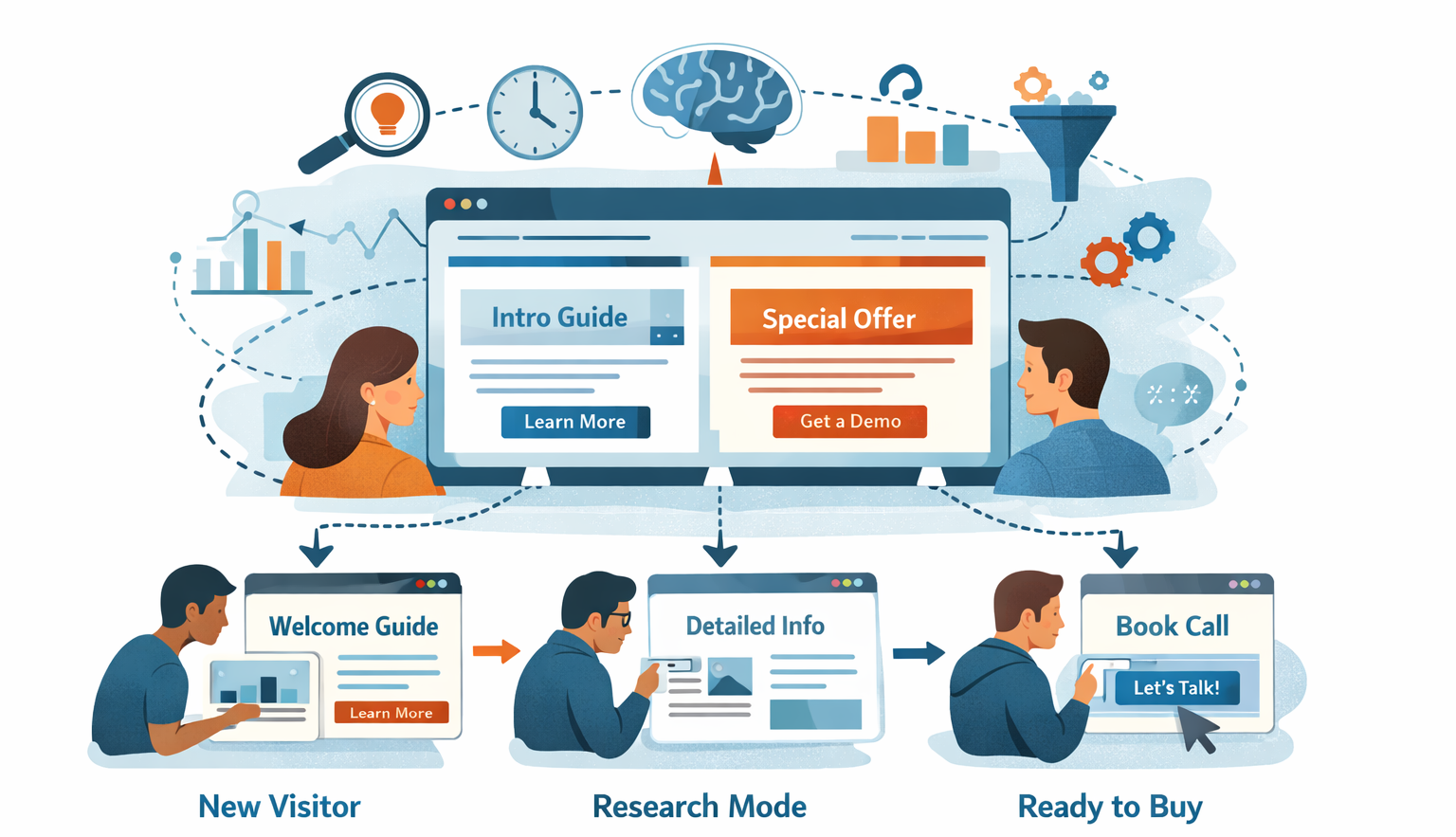
Micro-personalization relies on signals, not assumptions.
Common signals include:
- Scroll depth and scroll speed
- Time spent on specific sections
- Repeat visits within a defined window
- Interaction with FAQs, pricing, or comparison content
- Entry source (search, referral, direct)
- Device type and screen constraints
These signals indicate readiness, confidence, and intent far more accurately than age, job title, or inferred demographics.
Behavior tells the truth. Personas often do not.
Also Read 👉🏼With the SEO Changes of 2025, What Does 2026 Have in Store for Organic Traffic?
How Tone Changes Without Breaking Brand Voice
A common fear among SMBs is that personalization will dilute brand consistency. In practice, the opposite is true.
Micro-personalization works within a defined brand voice. It adjusts delivery, not identity.
For example:
- Exploratory visitors encounter calm, explanatory language
- Hesitant visitors see reassurance and social proof
- High-intent visitors encounter confident, direct phrasing
The brand remains recognizable.
The conversation simply becomes more appropriate.
Dynamic Content Length: Respecting Attention in Real Time
Not all visitors want the same level of detail.
Some skim.
Some research deeply.
Some already know what they need.
Micro-personalization allows:
- Concise summaries for fast movers
- Expanded explanations for careful readers
- Progressive disclosure instead of forced scrolling
- Key takeaways surfaced earlier for skimmers
This is not about hiding information.
It is about serving it when it’s actually useful.
Offer Personalization Without Pressure
Calls-to-action are often where websites become aggressive or tone-deaf.
Micro-personalization introduces restraint.
Examples include:
- Educational offers for early-stage visitors
- Case studies or proof points for comparison shoppers
- Consultations or demos for high-intent users
- Reduced friction CTAs for mobile or time-constrained visitors
The goal is not to push harder.
The goal is to match timing.
Why Micro-Personalization Is Especially Powerful for SMBs
Large brands can survive impersonal digital experiences. SMBs rarely can.
For SMBs:
- Traffic acquisition costs are higher
- Trust must be established faster
- Differentiation often lives in communication quality
Micro-personalization allows smaller businesses to:
- Appear attentive without being invasive
- Feel human without requiring live interaction
- Compete with larger brands through relevance, not scale
It is a force multiplier—not a luxury.
Also Read 👉🏼From Clicks to Clients — The Power of Organic SEO and GEO Targeting
Ethics, Trust, and the End of “Creepy” Personalization
Poor personalization feels manipulative. Good micro-personalization feels polite.
Ethical implementation means:
- No sensitive data inference
- No false urgency
- No dark patterns
- Clear value exchange
When done correctly, visitors rarely notice personalization itself.
They simply feel understood.
That is the difference between manipulation and design intelligence.
The Future of SMB Websites
Websites are no longer static destinations. They are interfaces for conversation.
In the coming years, high-performing SMB websites will:
- Adapt faster than they redesign
- Respond instead of repeat
- Guide rather than overwhelm
- Earn trust through relevance
Micro-personalization is not a trend.
It is the baseline expectation for digital credibility moving forward.
People Also Ask (FAQs)
1. What is micro-personalization in web design?
Micro-personalization is the practice of adjusting website content in real time based on user behavior, such as scrolling, engagement, and visit frequency.
2. How is micro-personalization different from traditional personalization?
Traditional personalization often relies on demographics or identity data, while micro-personalization uses real-time behavioral signals.
3. Do SMBs need AI to implement micro-personalization?
No. Many micro-personalization strategies rely on lightweight logic and modular content rather than advanced AI systems.
4. Is micro-personalization invasive to user privacy?
When implemented ethically, it relies on anonymous behavior patterns, not personal or sensitive data.
5. Can micro-personalization improve conversion rates?
Yes. By matching content to visitor readiness, micro-personalization often increases engagement and conversion efficiency.
6. Does micro-personalization affect SEO?
When done correctly, it enhances engagement signals without harming crawlability or search visibility.
7. How complex is micro-personalization to maintain?
It is typically easier to maintain than constant redesigns because it relies on modular content blocks.
8. Can micro-personalization work on existing websites?
Yes. It can often be layered onto existing architectures with minimal disruption.
9. What industries benefit most from micro-personalization?
Service-based SMBs, B2B providers, professional services, and high-consideration purchases benefit significantly.
10. Is micro-personalization a long-term strategy?
Yes. As user expectations evolve, adaptive experiences are becoming a foundational requirement rather than a differentiator.