
The Quiet Shift Already Underway
For most of the past decade, SMB marketing has been stuck in a strange limbo. Tools became cheaper, platforms multiplied, and automation promised relief—but brand storytelling never truly scaled. Businesses scheduled posts, reused taglines, and swapped templates, yet the story itself remained frozen while customers evolved in real time.
By late 2025, that mismatch has become impossible to ignore. Customers expect relevance that feels human, immediate, and consistent across email, web, social, search, and even customer service. SMBs, meanwhile, are juggling lean teams, tighter margins, and rising competition from AI‑augmented peers.
This pressure sets the stage for a new category to break through in 2026: automated brand story engines.
What is SMB Marketing
What a Brand Story Engine Actually Is (and Isn’t)
A brand story engine is not a content generator in the traditional sense. It is not a library of prompts, canned tone sliders, or prewritten personas.
Instead, it functions as a narrative operating system.
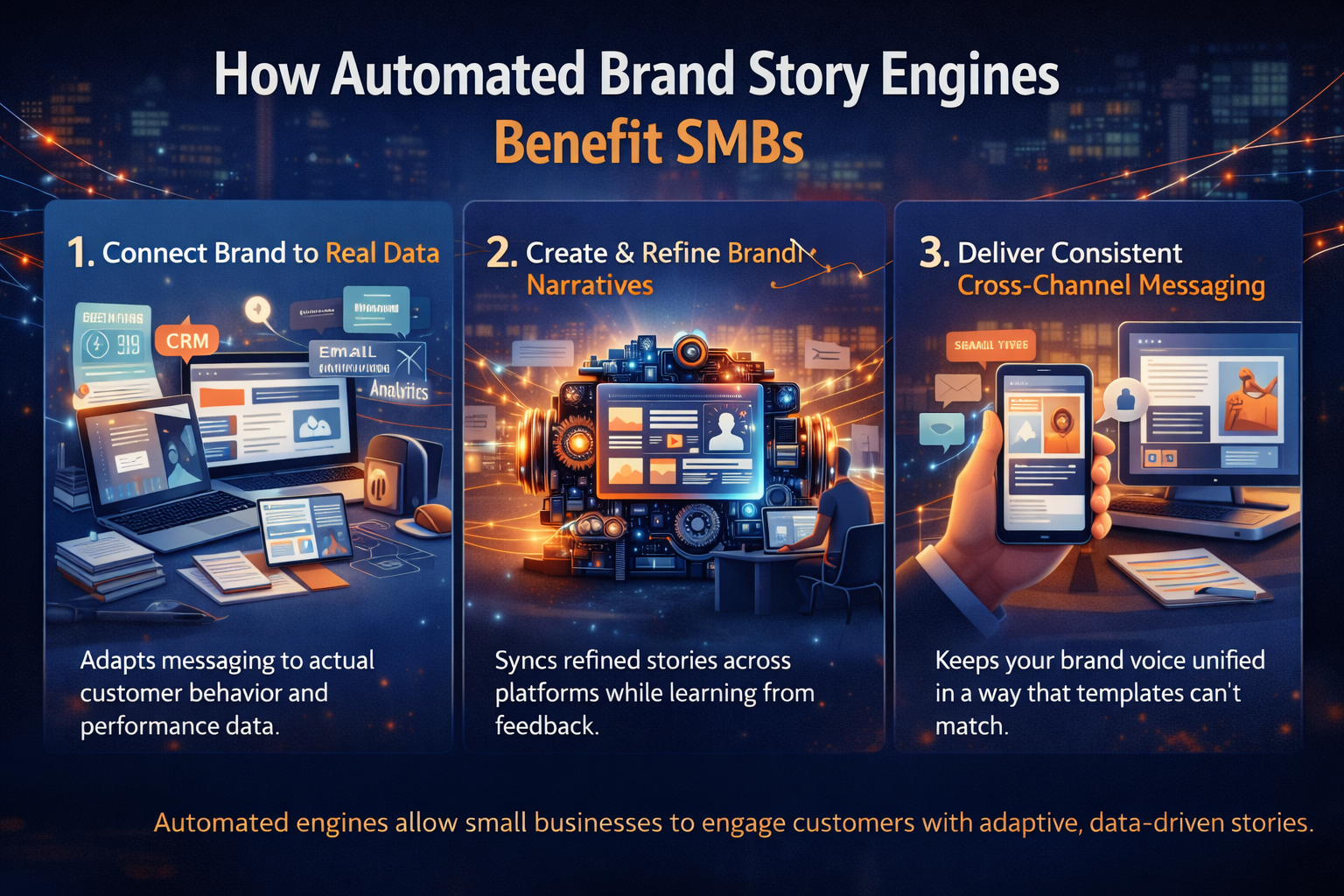
At its core, a story engine continuously ingests real‑world signals—CRM data, customer feedback, purchase behavior, web interactions, location context, seasonality, and channel performance. It then translates those signals into adaptive brand narratives that remain structurally consistent while dynamically adjusting language, emphasis, and framing.
The difference is subtle but profound:
Templates repeat. Engines learn.
Also Read 👉🏼The New ROI: How Can Emotional Engagement Be Measured Beyond Click-Through Rates?
Why 2026 Is the Inflection Point
1. Data Unification Finally Becomes Accessible to SMBs
Until recently, only large enterprises could afford to unify marketing, sales, support, and behavioral data into a single system. In 2026, API‑first SaaS platforms, composable CRMs, and AI‑native middleware make this integration affordable and manageable for SMBs.
Once data unifies, static storytelling collapses. A business can no longer justify sending the same message to a first‑time visitor and a ten‑year client.
2. Generative AI Grows Context‑Aware, Not Just Fluent
The leap from 2024–2025 to 2026 is not about better grammar or creativity. It is about contextual grounding.
Modern models increasingly anchor outputs to live data sources, brand rules, compliance constraints, and audience state. That makes automated storytelling trustworthy enough to run continuously—without a human rewriting every sentence.
3. Search, Social, and Email All Demand Narrative Consistency
Search engines now reward topical authority and coherence across an entire digital footprint. Social platforms penalize repetitive or hollow content. Email providers measure engagement at a granular, behavioral level.
Brand story engines solve this by acting as a single narrative brain that expresses itself differently per channel while preserving meaning, values, and positioning.
Also Read 👉🏼How Can Micro-Personalization Help SMB Websites Feel Human?
From Campaigns to Living Narratives
Traditional marketing works in bursts: campaigns, launches, promotions. Story engines dissolve that rhythm.
In 2026, high‑performing SMBs will operate with living narratives that:
- Shift emphasis based on customer lifecycle stage
- Highlight different proof points as trust increases
- Adjust emotional framing based on behavior, not guesswork
- Maintain voice integrity even as platforms change
The story does not reset every quarter. It evolves.
Real‑World Data as the Story’s Spine
The most important change is philosophical. Brand stories stop being aspirational slogans and become mirrors of reality.
When an engine sees that customers respond to sustainability proof more than price claims, the narrative pivots. When retention improves after educational content, the story leans into authority. When a region behaves differently, the language adapts without fragmenting the brand.
This is not personalization theater. It is narrative intelligence.
Why SMBs, Not Enterprises, Will Lead Adoption
Large organizations move slowly. Governance layers, legal reviews, and internal politics delay experimentation.
SMBs, by contrast, have three advantages:
- Fewer decision‑makers
- Clearer brand identities
- Immediate feedback loops
In 2026, the SMB that adopts a story engine gains something enterprises envy: speed without chaos.
The Competitive Gap That Will Open Fast
Once a story engine is deployed, the gap widens quickly.
Brands using engines:
- Publish faster without losing coherence
- Learn from every interaction automatically
- Reduce dependency on fragmented freelancers and agencies
- Build trust through consistency instead of volume
Brands without them will sound increasingly generic—no matter how often they post.
Also Read 👉🏼2026 Business Strategy Checkup | Pilgrim Consulting & Design
The Ethical Layer: Why Trust Still Matters
Automated storytelling only works if trust is preserved.
The winning engines of 2026 will include:
- Transparent data usage
- Guardrails against manipulation
- Clear brand value constraints
- Human oversight at the strategic level
The goal is not to remove humans from storytelling. It is to remove friction.
What Adoption Looks Like in Practice
For most SMBs, adoption will not be dramatic. It will start quietly:
- A unified brand narrative layer feeding web, email, and social
- Real‑time tone adjustments based on engagement
- Automatic refinement of messaging as data accumulates
Within months, teams will wonder how they ever managed without it.
The Bottom Line
2026 will not be remembered as the year SMBs used more AI. It will be remembered as the year brands stopped writing stories and started running them.
Automated brand story engines are not a trend. They are the natural evolution of storytelling in a data‑rich, attention‑scarce world—and SMBs are perfectly positioned to lead the shift.
FAQs
1. What is an automated brand story engine?
It is a system that uses real customer data and behavioral signals to continuously generate and refine a brand’s narrative across channels.
2. How is this different from AI content generators?
Content generators produce isolated outputs; story engines maintain narrative consistency and learn over time.
3. Why will SMBs adopt this faster than enterprises?
SMBs move faster, have simpler brand structures, and benefit immediately from efficiency gains.
4. Does this replace human marketers?
No. It removes repetitive execution while humans retain strategy, ethics, and creative direction.
5. What data powers a brand story engine?
CRM data, customer behavior, engagement metrics, feedback, and contextual signals.
6. Is automated storytelling risky for brand voice?
Only without guardrails. Properly designed engines protect and reinforce brand voice.
7. How does this affect SEO?
Consistent, coherent narratives improve topical authority and engagement signals.
8. Can small teams manage these systems?
Yes. They are designed to reduce workload, not increase it.
9. When should an SMB adopt one?
Early 2026 offers a first‑mover advantage before the category becomes saturated.
10. Is this a long‑term shift?
Yes. Narrative automation is becoming foundational infrastructure, not a trend.