
Why Traditional Operations Audits Are No Longer Enough
Most organizations still audit operations the same way they did a decade ago:
by looking backward.
They review performance after deadlines slip.
They investigate staffing issues after burnout appears.
They address client dissatisfaction after the relationship is already damaged.
Traditional audits are diagnostic. They explain what happened.
In a volatile, fast-moving business environment, that’s no longer sufficient.
The question leaders need answered now is simpler—and harder:
What is about to go wrong if nothing changes?
From Reporting the Past to Forecasting the Future
A Future Operations Audit represents a fundamental shift in how operational intelligence is used.
Instead of relying solely on lagging indicators like:
- Monthly KPIs
- Utilization reports
- Historical service metrics
Pilgrim Consulting & Design focuses on leading indicators—patterns that quietly predict failure or friction before they become visible problems.
This isn’t guesswork.
It’s applied predictive analytics grounded in operational reality.
Also Read 👉🏼2026 Business Strategy Checkup | Pilgrim Consulting & Design
What a Future Operations Audit Actually Examines
Pilgrim CD’s approach integrates data across departments, systems, and workflows to identify signals most organizations overlook.
Key areas include:
Workflow Dynamics
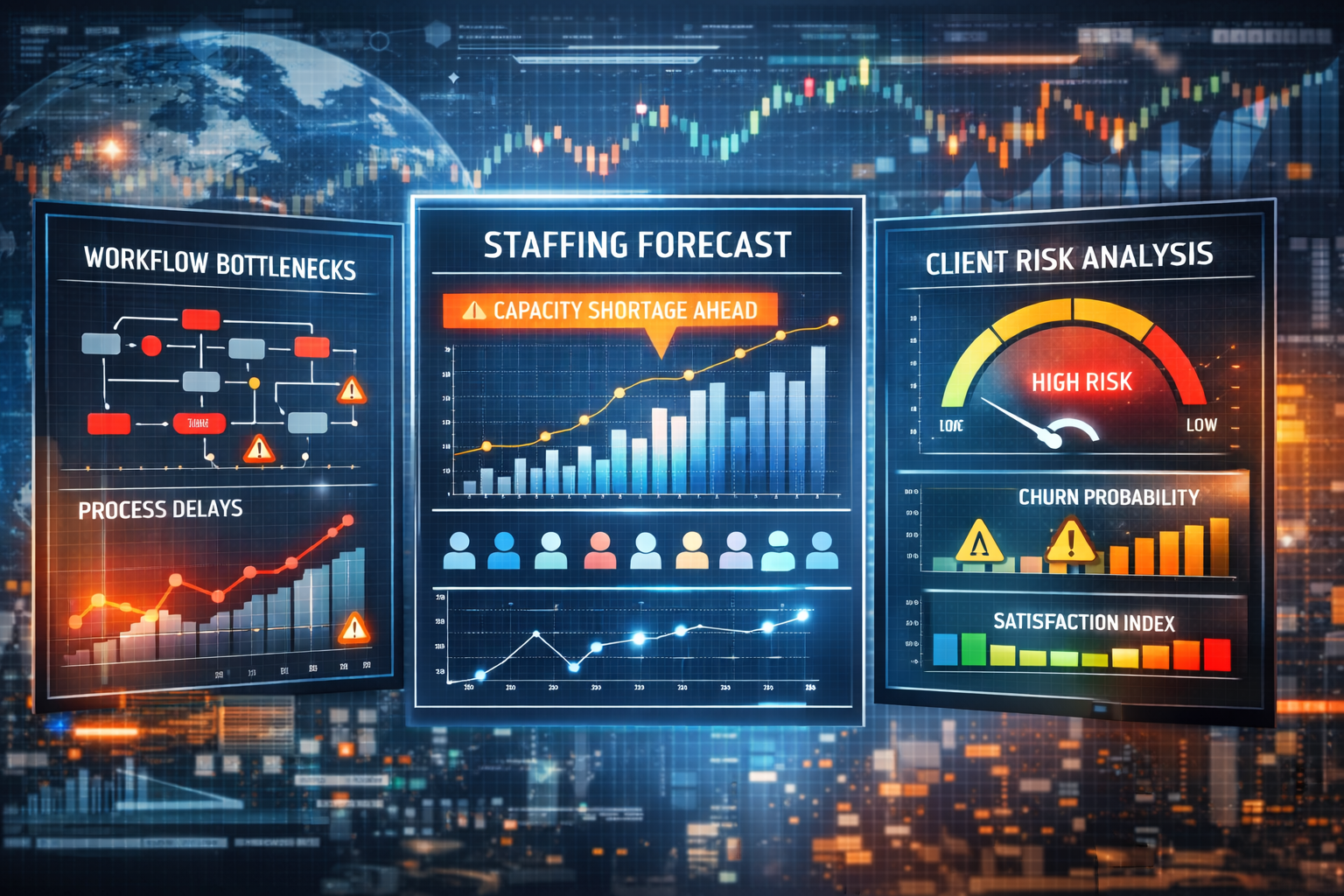
Patterns such as task aging, rework frequency, approval delays, and handoff friction reveal where processes will bottleneck under future demand.
Staffing Pressure Signals
Volatility in utilization, schedule compression, role overload, and context switching often predict burnout, turnover, or performance degradation weeks—or months—before it occurs.
Client Satisfaction Precursors
Small shifts in response time, communication cadence, scope creep density, and service consistency statistically precede disengagement long before a client voices dissatisfaction.
Revenue and Risk Correlations
Operational strain rarely stays isolated. Pilgrim CD analyzes how workflow and staffing stress correlate with margin erosion, churn risk, and missed growth opportunities.
The result is not a static report—it’s a forecast model of operational behavior.
Predicting Bottlenecks Instead of Reacting to Them
One of the most valuable outcomes of a Future Operations Audit is bottleneck prediction.
Instead of discovering:
“We’re suddenly behind schedule and under-resourced”
Leaders gain visibility into:
“In 45 days, two high-priority initiatives will compete for the same constrained expertise—and one will fail without intervention.”
That difference is everything.
When bottlenecks are predicted early, organizations can:
- Adjust staffing plans proactively
- Rebalance workloads intelligently
- Redesign workflows before stress compounds
- Protect client relationships before trust erodes
This is operational resilience by design, not by accident.
Why Predictive Operations Matter More in 2026 and Beyond
Organizations are operating in an environment defined by:
- Leaner teams
- Higher client expectations
- Faster delivery cycles
- Less tolerance for inefficiency
In this context, reactive management becomes a hidden tax—on people, performance, and profitability.
Predictive operational intelligence gives leaders something rare:
time.
Time to intervene before problems escalate.
Time to make deliberate decisions instead of emergency ones.
Time to lead, rather than constantly recover.
The Pilgrim Consulting & Design Difference
Pilgrim CD doesn’t believe analytics should live in dashboards that leaders glance at once a month.
Their Future Operations Audits translate complexity into:
- Clear operational foresight
- Actionable decision paths
- Practical recommendations leadership can execute
The goal isn’t surveillance.
It’s clarity.
Pilgrim CD helps organizations understand how their systems behave under pressure—and how to guide them before pressure becomes damage.
Also Read 👉🏼Professional Web Design Services | Pilgrim Consulting & Design
Conclusion: Managing Tomorrow, Not Yesterday
Reporting tells you where you’ve been.
Audits explain what went wrong.
Predictive analytics tell you where you’re headed—and whether you’ll like the destination.
The Future Operations Audit enables leaders to stop managing history and start shaping outcomes.
With Pilgrim Consulting & Design, operations become not just efficient—but intelligently prepared for what’s coming next.
FAQs
1. What is a Future Operations Audit?
A Future Operations Audit evaluates operational systems using predictive analytics to identify risks, bottlenecks, and capacity issues before they impact performance, clients, or revenue.
2. How is a Future Operations Audit different from a traditional audit?
Traditional audits analyze past performance. A Future Operations Audit forecasts likely operational failures, staffing strain, and client risks based on leading indicators and trend patterns.
3. What types of problems can predictive analytics uncover early?
Predictive analytics can reveal workflow bottlenecks, staffing shortages, burnout risk, delivery delays, margin erosion, and declining client satisfaction weeks or months in advance.
4. What data is used in a Future Operations Audit?
Data typically includes workflow metrics, utilization rates, task aging, rework frequency, communication patterns, staffing capacity, and client interaction signals—integrated across systems.
5. How does a Future Operations Audit improve staffing decisions?
It forecasts future capacity constraints, highlights role overload, and identifies where staffing adjustments or process redesigns are needed before burnout or turnover occurs.
6. Can a Future Operations Audit help reduce client churn?
Yes. By identifying early warning signs—such as response-time drift or service inconsistency—it enables proactive intervention before dissatisfaction escalates into churn.
7. Is a Future Operations Audit only for large enterprises?
No. Mid-sized organizations often benefit the most because they face growth pressure without enterprise-level redundancy, making early risk detection especially valuable.
8. How long does a Future Operations Audit typically take?
Most audits are conducted over 60–90 days, allowing enough data to model trends while delivering actionable insights quickly.
9. What outcomes should leaders expect from the audit?
Leaders gain operational foresight, prioritized risk areas, predictive scenarios, and clear recommendations that support proactive decision-making rather than reactive fixes.
10. Why work with Pilgrim Consulting & Design for this type of audit?
Pilgrim CD combines systems thinking, operational expertise, and applied analytics to translate complex data into clear, strategic actions leaders can implement with confidence.