
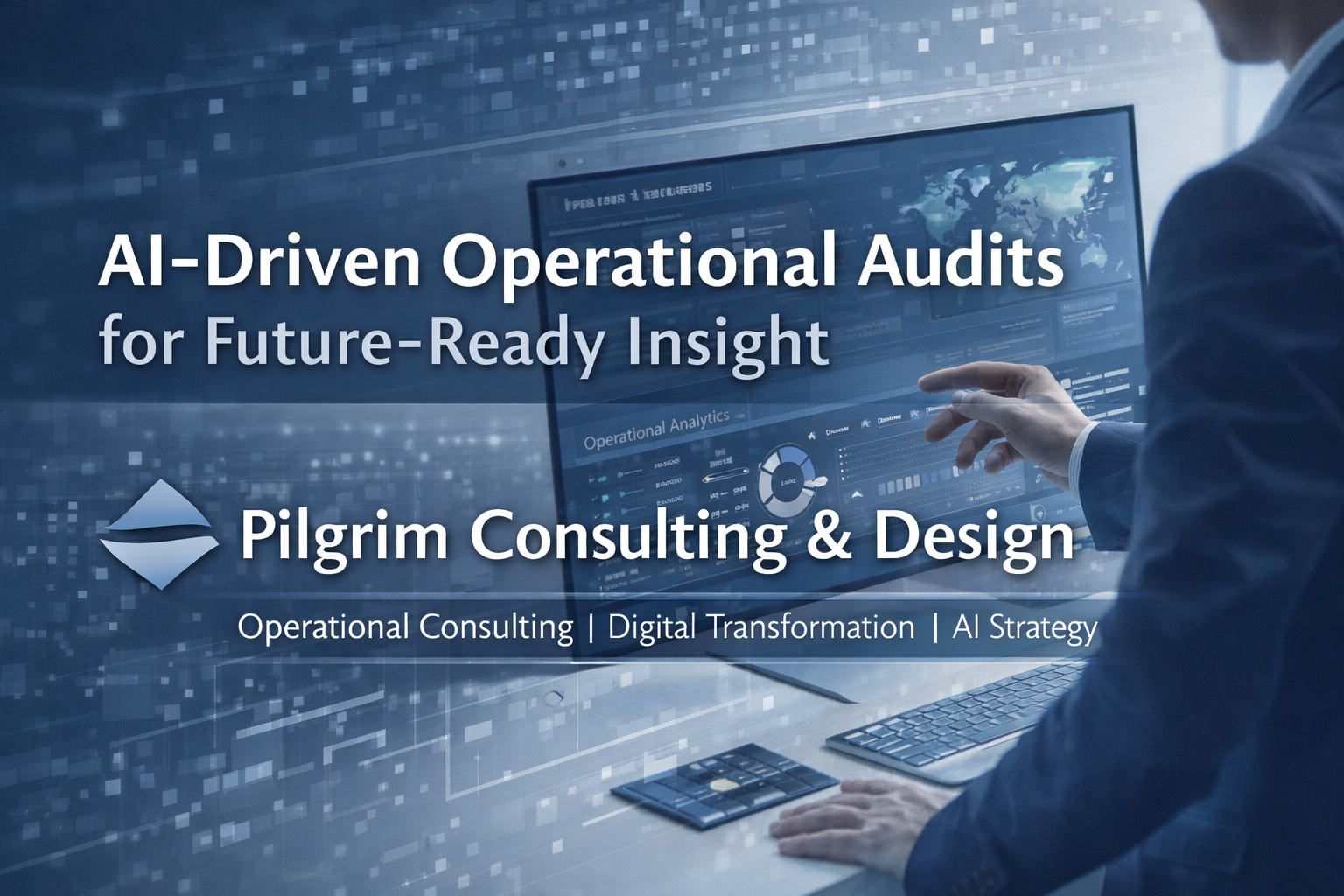
Quick Answer: AI-driven operational audits are replacing manual business reviews because they analyze full-system data objectively, continuously, and at scale. Unlike traditional audits that rely on interviews, sampling, and consultant interpretation, AI identifies process inefficiencies, bottlenecks, and compliance gaps using actual operational behavior across departments and systems. When integrated ethically and guided by experienced consultants, AI enables faster, more accurate decision-making while maintaining human oversight, regulatory compliance, and organizational accountability.
 The Problem: Traditional Business Reviews Can No Longer Keep Up
Operational audits were never designed for the velocity, complexity, and data density of modern organizations. Yet most businesses—across industries and geographies—are still relying on review models built for a slower, simpler era.
Manual business reviews depend heavily on interviews, limited data samples, static process maps, and consultant intuition. While experience matters, this approach creates three systemic risks: incomplete visibility, human bias, and delayed insight. By the time findings are delivered, conditions on the ground have already changed.
As organizations scale digitally, inefficiencies no longer announce themselves loudly. They hide in workflow handoffs, software overlaps, approval latency, data silos, and decision bottlenecks that only become visible when analyzed at full-system scale. Manual reviews cannot do this consistently, quickly, or objectively.
The result is a widening gap between perceived performance and actual operational reality.
Background: The Explosion of Operational Data
Every modern organization is now a data-producing system. Financial transactions, customer interactions, employee activity, system logs, supply chain movements, and compliance records generate continuous operational exhaust.
Historically, most of this data went unused. Consultants sampled. Leaders inferred. Decisions were made on partial information because full analysis was technically impractical.
That constraint no longer exists.
Machine learning systems can ingest, normalize, and analyze vast datasets across departments and platforms simultaneously. They do not require perfect data hygiene to extract patterns. They excel at detecting anomalies, correlations, and inefficiencies that humans routinely miss.
What has changed is not ambition—it is capability.
A Brief History of Operational Auditing (and Its Limits)
Traditional operational audits evolved from financial audits, which prioritize accuracy, compliance, and retrospective validation. Over time, consulting firms adapted these methods to assess efficiency, governance, and organizational design.
But the methodology remained fundamentally linear:
- Observe
- Interview
- Sample
- Conclude
This worked when systems were smaller and change cycles were longer. It fails in digitally transformed environments where processes are dynamic, interdependent, and algorithmically mediated.
Regulatory pressure has further complicated the picture. Data privacy laws such as GDPR and CCPA require organizations to understand how data flows across systems and jurisdictions. Emerging AI governance frameworks—such as the EU AI Act and evolving U.S. standards—add additional layers of accountability, transparency, and risk management.
Manual audits were never built to map this level of complexity in real time.
The Shift: What AI-Driven Operational Audits Actually Do
AI-driven operational audits are not about replacing professional judgment. They are about extending it.
At their core, these audits use machine learning models to analyze full-population operational data rather than small samples. They identify process bottlenecks, redundancy, delay, cost leakage, and policy drift with statistical precision.
They surface where processes deviate from documented procedures, where approvals stall, where resources are under- or over-utilized, and where systems silently work against each other.
Most importantly, AI models can simulate alternative scenarios—showing leaders what would likely happen if a process step were removed, automated, reordered, or reassigned—before any real-world disruption occurs.
This turns audits from retrospective assessments into forward-looking decision tools.
Beyond Human Bias: Why Objectivity Matters
Even the most experienced consultants are human. Interviews are shaped by incentives. Narratives are shaped by power structures. Assumptions quietly harden into conclusions.
AI systems do not participate in organizational politics. They analyze behavior, not intention. If a department consistently delays outcomes, the data reflects it. If policies exist only on paper, usage patterns expose the gap.
This objectivity is particularly valuable in global, multi-industry environments where leadership teams are geographically and culturally dispersed. Consistent, data-driven analysis creates a shared factual baseline for decision-making.
That baseline is increasingly non-negotiable.
 The Consultant’s Role in an AI-Driven World
 The Consultant’s Role in an AI-Driven World
AI does not understand context, culture, or consequence. Consultants do.
At Pilgrim Consulting & Design, AI-driven audits are positioned as a strategic advisory capability, not a product or toolset. The value lies in guiding organizations through intelligent integration—selecting appropriate approaches based on operational maturity, workforce skill level, and business objectives.
A highly technical enterprise may benefit from advanced analytics and automation. A small business with limited digital literacy requires simpler, interpretable systems. One size does not fit all, and ethical consulting demands restraint as much as innovation.
Consultants remain responsible for:
- Interpreting results
- Prioritizing interventions
- Managing change
- Aligning recommendations with legal, cultural, and strategic realities
AI informs decisions. Humans remain accountable for them.
Legal and Ethical Considerations: Getting This Right
AI-driven audits intersect directly with data privacy and governance obligations.
Under GDPR and CCPA-style frameworks, organizations must understand what data is collected, how it is processed, and for what purpose. AI analysis must respect consent boundaries, data minimization principles, and security requirements.
Emerging AI governance regulations emphasize transparency, explainability, and human oversight. Black-box recommendations without clear rationale will increasingly be viewed as compliance and reputational risks.
Ethical AI integration requires:
- Clear data governance policies
- Explainable analytical models
- Human review of all material findings
- Transparent communication with stakeholders
Efficiency without accountability is not progress—it is exposure.
Solutions: How Organizations Should Move Forward
The replacement of manual audits will not be abrupt, but it is inevitable.
Organizations should begin by:
- Using AI to augment—not replace—existing review processes
- Focusing on high-impact operational areas first
- Selecting analytical approaches aligned with workforce capability
- Embedding governance and privacy considerations from the start
Consulting firms that guide this transition thoughtfully will move upstream—from operational cleanup to strategic transformation.
Why This Matters in 2026 and Beyond
By 2026, expectations will shift. Boards, regulators, and investors will increasingly view AI-assisted operational insight as standard practice, not innovation.
Firms that rely solely on manual reviews will appear slow, subjective, and under-equipped for modern risk environments. Those that integrate AI ethically and intelligently will deliver faster clarity, stronger confidence, and more resilient organizations.
The future belongs to consultants who combine machine intelligence with seasoned judgment—and know precisely where each belongs.
Evolution, Not Disruption
Manual business reviews will not disappear overnight. But they will no longer stand alone.
Organizations that adapt now will lead with evidence, integrity, and foresight. Those that do not will struggle to explain decisions made without seeing the full picture.
Pilgrim Consulting & Design operates where clarity meets responsibility—guiding organizations worldwide through operational transformation with intelligence, ethics, and discipline.
Consultation CTA:
To explore how AI-informed operational insight can strengthen your organization without compromising trust or governance, contact Pilgrim Consulting & Design for a strategic consultation.
Also Read 👉🏼With the SEO Changes of 2025, What Does 2026 Have in Store for Organic Traffic?
Have More Questions? Check these out!
 What is an AI-driven operational audit?
An AI-driven operational audit uses machine learning to analyze full operational data sets to identify inefficiencies, risks, and process breakdowns more accurately than manual reviews.
How does AI reduce bias in business reviews?
AI evaluates actual operational behavior across systems rather than opinions or interviews, reducing human bias and revealing patterns based on evidence, not assumptions.
Can small businesses benefit from AI audits?
Yes. AI audits can be scaled to match a business’s size and technical skill level, providing targeted insights without requiring complex systems or large teams.
Does AI replace human consultants?
No. AI supports consultants by providing deeper analysis, while humans remain responsible for interpretation, strategy, ethics, and change management.
How are data privacy laws handled in AI audits?
AI audits must follow data privacy laws such as GDPR and CCPA by using controlled access, data minimization, transparency, and human oversight.
Are AI operational audits industry-specific?
AI operational audits are adaptable across industries because they analyze processes and data flows rather than relying on industry-specific assumptions.
What risks exist with AI-based analysis?
Risks include poor data quality, overreliance on automated outputs, and lack of governance if human oversight and explain ability are not maintained.
How long does an AI-driven audit typically take?
Depending on scope and data readiness, AI-driven audits typically take weeks rather than months, delivering faster insight than traditional reviews.
What role does governance play in AI adoption?
Governance ensures AI is used responsibly by defining accountability, transparency, compliance standards, and decision-making authority.
How should organizations prepare for AI-assisted audits?
Organizations should assess data quality, define audit goals, establish governance policies, and involve experienced consultants to guide ethical integration.