
From Digital Brochure to Authority Engine: How to Build a Website That Earns Trust Before the First Click
Executive Summary
⏱️60 second read
For years, most business websites were built like digital brochures.
They introduced the company, listed services, displayed a few testimonials, provided contact information, and waited for customers to arrive.
That model worked reasonably well when the typical customer journey started with a search engine, moved through several websites, and ended with a phone call or form submission.
AI-assisted search is changing that journey.
Potential customers can now research problems, compare solutions, learn terminology, evaluate approaches, and discover potential providers before visiting a company website. Google reports that AI Mode surpassed one billion monthly users in 2026, while queries more than doubled each quarter following launch.
The website therefore has a larger job.
It must act as a knowledge source, authority signal, validation environment, machine-accessible information layer, and conversion engine at the same time.
At Pilgrim Consulting & Design, we call this evolution the Digital Authority Engine.
The companies that understand this transition will stop treating websites as online brochures and start building interconnected knowledge systems that help establish authority before the customer ever clicks.
Full Article
Estimated Reading Time: 14–16 Minutes
⬇️⬇️⬇️⬇️
Key Takeaways
- A modern website must do more than describe a business; it must demonstrate expertise.
- AI search makes firsthand experience and unique content increasingly important.
- Technical SEO remains foundational rather than obsolete.
- Topic clusters and internal linking help turn disconnected pages into knowledge architecture.
- Entity clarity helps search and AI systems understand who the organization is.
- Trust must be demonstrated through evidence, not simply claimed.
- Conversion strategy becomes more important when visitors arrive better informed.
- The strongest digital presence is not simply a website. It is an interconnected Digital Authority Hub.
The Website Problem Most Businesses Don't Realize They Have

Many companies have websites that look perfectly respectable.
The homepage is attractive.
The services are listed.
There is an About page.
There may be testimonials, a contact form, social links, and a blog that receives an occasional new article.
Technically, the company has a website.
Strategically, it may still have very little digital authority.
That distinction matters.
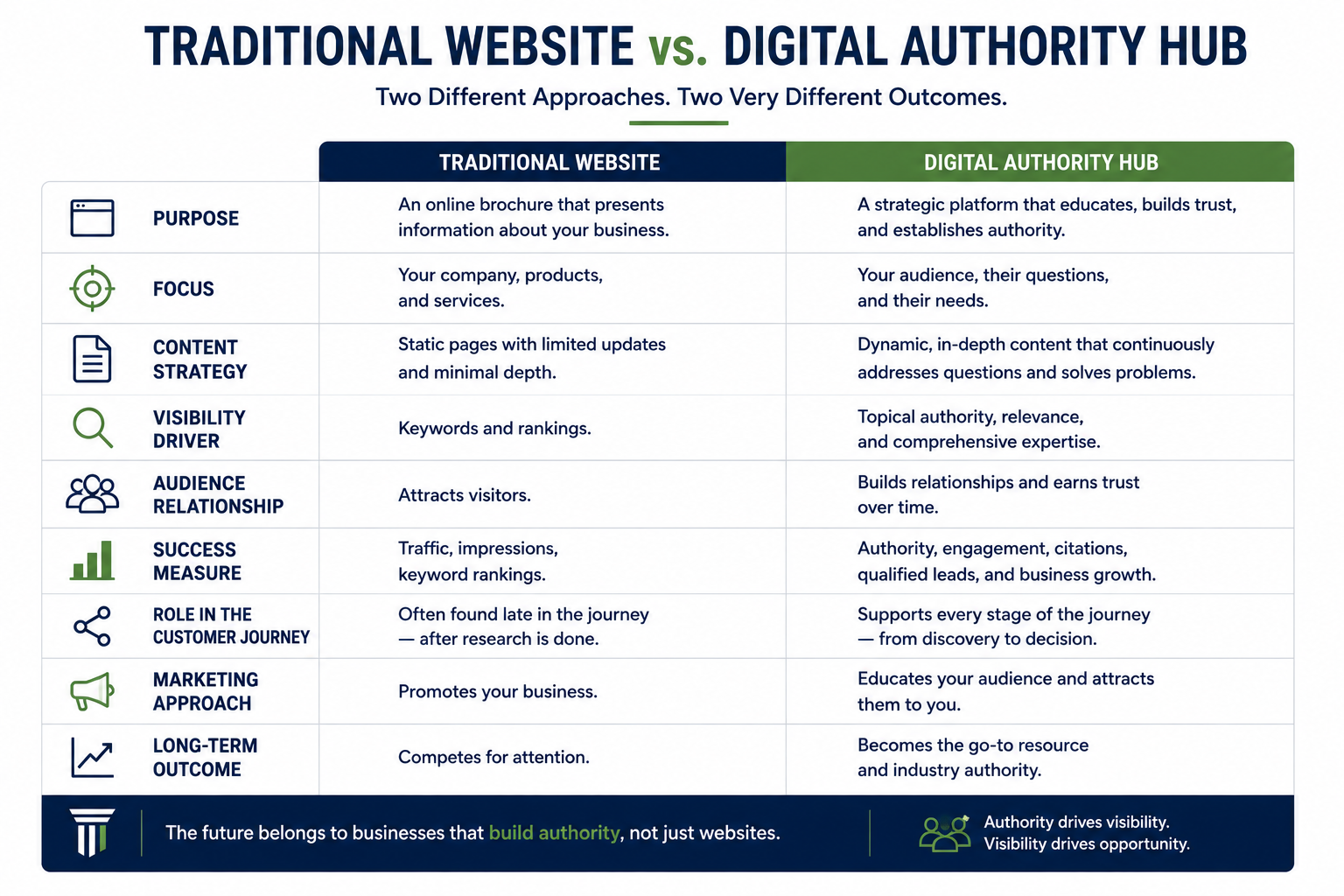
A traditional business website tells visitors:
Here is who we are. Here is what we sell. Here is how to contact us.
A Digital Authority Hub answers much larger questions:
What does this company actually know?
How deeply does it understand the customer's problem?
What evidence supports its expertise?
Can its information be discovered and understood outside the website itself?
Does the organization contribute useful knowledge—or merely advertise itself?
Those questions are becoming increasingly important because discovery is changing.
Also Read 💻AI Search & the New Customer Journey | Pilgrim Consulting
The Traditional Website Was Designed Around the Click
For much of the modern internet era, businesses followed a predictable digital model:
Rank → Click → Website → Learn → Trust → Contact
The website carried most of the burden.
Customers reached the site early in their research process and depended on the company's pages to explain the problem, educate them about solutions, and convince them to take action.
AI-assisted discovery increasingly changes the order.
Today the journey may look more like:
Question → AI/Search Research → Solution Discovery → Authority Recognition → Website Validation → Comparison → Decision
That does not make the website less important.
It makes the website more accountable.
By the time some prospects reach a company website, they may already understand the terminology, know several competing solutions, have researched alternative providers, and possess a sophisticated list of questions.
The website is no longer introducing the entire subject from scratch.
It is being asked to prove that the company belongs in the conversation.
Also Read 💻Why Traditional Business Websites Are Dying (And What Replaces Them)
Google's Own Guidance Points in the Same Direction
One reason businesses should be skeptical of supposed “AI SEO secrets” is that Google's own guidance is much more grounded.
Google states that traditional SEO practices remain relevant to generative AI search because AI features such as AI Overviews and AI Mode continue to rely on Google's core Search systems. Google's 2026 guidance specifically discusses technologies including retrieval-augmented generation and query fan-out while continuing to emphasize crawlability, useful content, page experience, clear structure, and technical accessibility.
Google's newer guidance goes even further.
It encourages businesses to create non-commodity content, develop unique points of view, contribute firsthand experience, organize information clearly, and use meaningful images and video. It specifically warns against simply recycling information that already exists or producing material that could easily be created generically by an AI model.
That should tell business owners something important.
The future is probably not about finding a clever trick that fools AI.
It is about becoming more genuinely useful.
Also Read 💻Why SEO Matters More Than Ever in the AI Visibility Era
The Pilgrim Digital Authority Framework™
At Pilgrim Consulting & Design, we organize the transformation from traditional website to Digital Authority Hub around seven interconnected layers.
The framework is designed around a simple principle:
A business should make its expertise accessible enough to discover, clear enough to understand, valuable enough to trust, and persuasive enough to act upon.
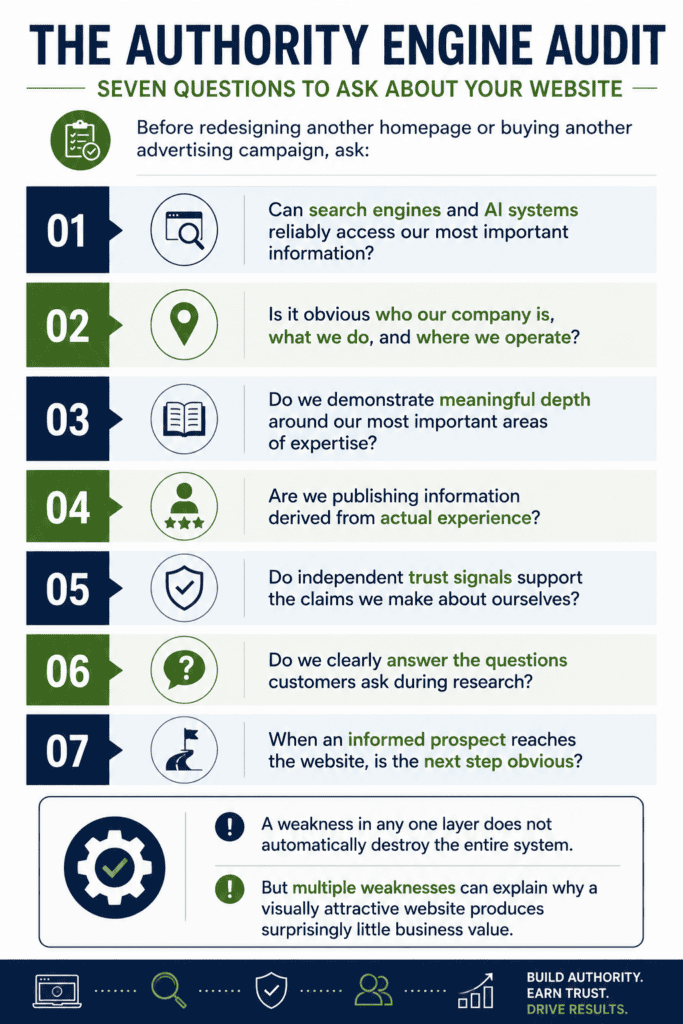
1. Technical Accessibility
Can search engines, users, and AI-powered systems reliably access and interpret your information?
Everything begins here.
A website should be:
- crawlable and indexable,
- mobile-friendly,
- fast and usable,
- logically structured,
- internally connected,
- accessible,
- descriptive in its headings and page titles,
- and supported by appropriate structured data when relevant.
Google continues to emphasize these fundamentals for both traditional Search and generative AI experiences.
Technical SEO is not an outdated discipline.
It is infrastructure.
2. Entity Clarity
Can digital systems clearly determine who your organization is?
Your business exists across more than its website.
Search engines and AI systems may encounter information about your organization through:
directories,
social platforms,
professional profiles,
reviews,
industry websites,
publications,
partnerships,
business listings,
videos,
and third-party mentions.
The information should consistently reinforce:
who you are,
where you operate,
what you specialize in,
who your experts are,
what services you provide,
and which audiences or industries you serve.
A fragmented digital identity creates uncertainty.
A consistent identity creates clarity.
3. Knowledge Depth
Does your website demonstrate enough subject depth to support the expertise you claim?
One optimized service page is not subject-matter authority.
Neither are fifty unrelated blog posts.
Businesses should build topic clusters around important areas of expertise.
A cybersecurity firm, for example, might create a core cybersecurity pillar supported by authoritative resources about ransomware, phishing, MFA, cyber insurance, backups, endpoint protection, compliance, employee training, incident response, Microsoft 365 security, and business continuity.
Each resource helps strengthen the others.
The website begins functioning as a knowledge system instead of a collection of isolated URLs.
4. Firsthand Evidence
This may become one of the most valuable differentiators in the AI era.
AI can summarize generic information extremely well.
What it does not automatically possess is your experience.
Businesses have access to knowledge such as:
customer questions,
field observations,
failure patterns,
proprietary processes,
before-and-after results,
operational data,
case studies,
benchmarks,
expert opinions,
and original research.
Google's current generative-search guidance explicitly emphasizes firsthand experience and unique viewpoints because they provide something beyond commodity information.
In other words:
The easier information becomes to reproduce, the more valuable experience becomes.
5. Trust Validation
A company cannot establish authority simply by repeatedly calling itself an expert.
Authority requires evidence.
That evidence may include:
customer reviews,
case studies,
credentials,
certifications,
professional affiliations,
expert authorship,
third-party recognition,
media mentions,
years of experience,
documented outcomes,
and transparent business information.
A modern authority website should make those trust signals easy to discover.
6. Answer Accessibility
Search behavior is becoming more conversational.
People increasingly ask complete questions rather than simply entering short keywords.
Pew Research Center found that longer Google searches and queries phrased as questions were substantially more likely to generate AI summaries than very short searches. In its analysis, only 8% of one- or two-word searches generated an AI summary, compared with 53% of searches containing ten words or more.
Businesses therefore need content that clearly answers actual customer questions.
Not simply:
commercial HVAC repair Denver
but:
Why does my commercial HVAC system keep short cycling?
How do I know whether my rooftop unit needs repair or replacement?
What causes uneven temperatures in commercial buildings?
How often should a commercial HVAC system be serviced?
Question-driven content aligns naturally with how people communicate with AI systems.
7. Conversion Readiness
Authority without action does not produce a business result.
A prospect arriving after extensive research may not need another lengthy explanation of the problem.
They may need:
proof,
clarification,
comparison,
pricing context,
case studies,
credentials,
next steps,
and an obvious way to talk to someone.
That means conversion architecture becomes even more important.
A Digital Authority Hub should make it easy to:
request a consultation,
call the business,
submit a quote request,
schedule a demonstration,
download a resource,
join an email list,
or take whatever step represents the next logical action.
The informed visitor should never have to wonder:
“What am I supposed to do now?”
Business Operations Analysis
The Framework Works as a System
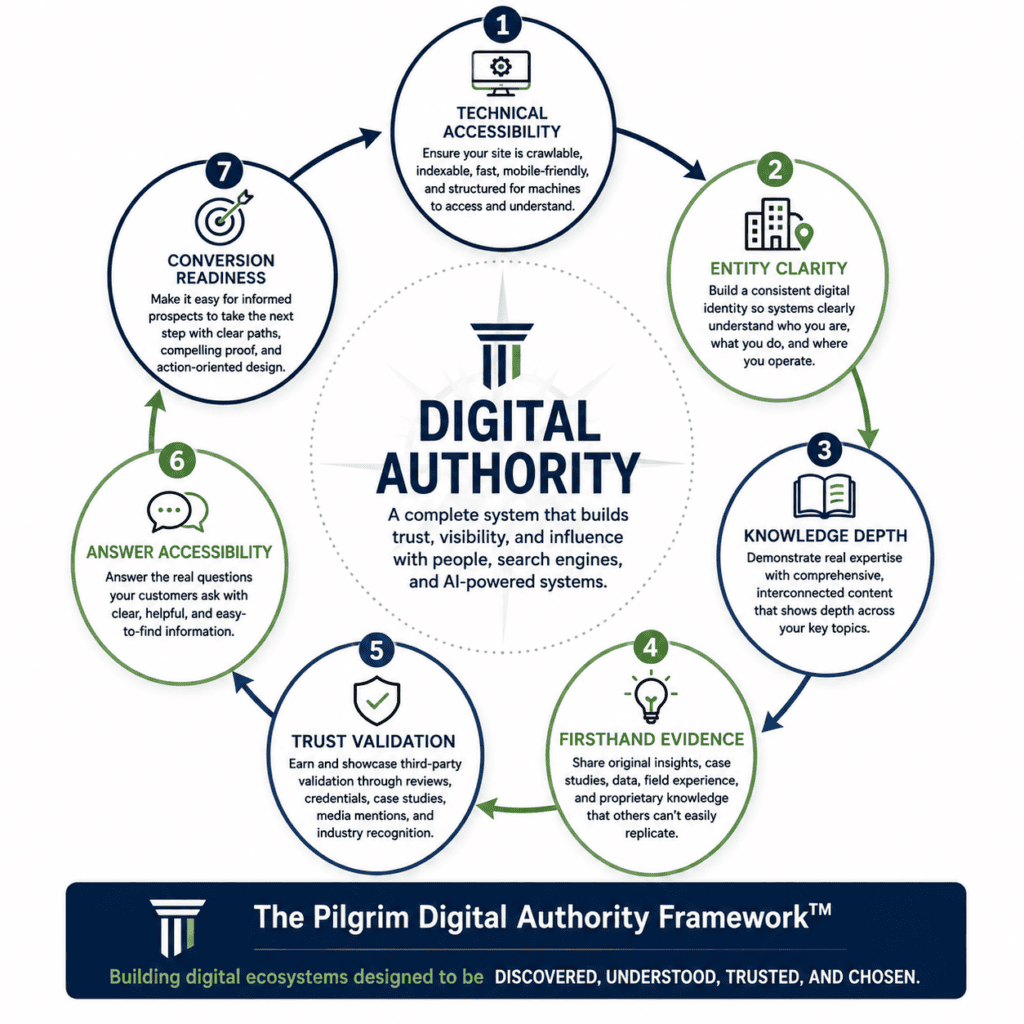
These seven layers reinforce one another.
Technical Accessibility makes the information discoverable.
Entity Clarity establishes who created it.
Knowledge Depth demonstrates expertise.
Firsthand Evidence makes that expertise distinctive.
Trust Validation helps confirm credibility.
Answer Accessibility makes expertise useful during research.
Conversion Readiness turns authority into opportunity.
Together, they create the Pilgrim Digital Authority Framework™:
Accessible → Understandable → Knowledgeable → Original → Trusted → Answerable → Actionable
That is what transforms a business website from a digital brochure into an Authority Engine.
Also Read 💻 The Pilgrim Advantage – Streamline, Optimize, and Supercharge Service Businesses
The Pilgrim Digital Authority Framework™ in Practice: A Real Client Example
Frameworks mean considerably more when they work in the real world.
One of Pilgrim Consulting & Design's service-business clients came to us after spending thousands of dollars on advertising with little meaningful return.
The owner was frustrated.
He had invested in trying to reach customers online, yet his business remained difficult to find within the geographic market he served.
Instead of recommending that he simply spend more money on advertising, we examined the underlying digital ecosystem.
The problem was not necessarily demand.
The company lacked the content architecture required to establish meaningful topical authority around its services.
From Five Services to Five Authority Pillars
We reorganized the website around five primary service categories.
Each category received a comprehensive authoritative pillar article designed to explain that area of expertise in depth.
Those pillars then became the foundations for supporting content.
For every major category, Pilgrim began creating articles addressing:
customer questions,
service problems,
educational topics,
misconceptions,
related solutions,
and subject-specific information.
Supporting articles linked back to their appropriate pillar resources.
Pillar resources linked to relevant service pages.
Related articles linked to one another where context justified it.
Relevant authoritative external resources strengthened subject matter where appropriate.
Website content was also connected outward through the company's social presence, creating another layer of digital distribution and entity reinforcement.
What had previously been a collection of pages began functioning as an interconnected knowledge ecosystem.
What Happened
Within approximately two months, the client's local search visibility increased dramatically for important service-related searches.
The company began appearing more prominently against competitors within its service area.
And the business gained significant traction without continuing to pour additional money into advertising.
The lesson was not that advertising is ineffective.
Advertising can be extraordinarily valuable when used strategically.
The lesson was:
Advertising rents attention. Digital authority builds an asset.
When paid promotion stops, paid visibility generally stops with it.
A strong authority ecosystem can continue creating visibility, educating customers, establishing trust, and generating opportunities long after the content is published.
Pilgrim Field Insight
Before spending more money trying to buy attention, determine whether the digital foundation is strong enough to capture the demand that already exists.
That is one of the most important distinctions between a traditional website and a Digital Authority Engine.
Social Media Optimization
Also Read 💻The Lead Generation War in 2026: SEO vs Email Marketing vs Direct Mail for Business Growth
Build Topics, Not Random Blog Calendars
One of the most common mistakes businesses make is treating blogging as a publishing schedule.
Tuesday arrives.
Someone realizes the company “needs a blog.”
An article gets produced.
Next month another unrelated article appears.
After several years, the website may contain dozens of posts that have almost no meaningful relationship to one another.
That is not knowledge architecture.
A stronger model starts with the company's actual expertise.
Imagine a core subject as the center of a wheel.
Around that subject are:
problems,
questions,
services,
comparisons,
mistakes,
definitions,
case studies,
regulations,
processes,
buyer considerations,
industry applications,
and future developments.
Those become supporting resources.
Internal linking then shows how those resources relate.
The website becomes navigable not only as a collection of pages but as a map of expertise.
Also Read 💻How Can Micro-Personalization Help SMB Websites Feel Human?
Internal Linking Is More Than an SEO Tactic

Internal links are often treated as a technical SEO checkbox.
They are much more important than that.
A good internal-linking system tells readers:
If you found this useful, here's what you should understand next.
It also tells search systems:
These topics belong together.
Internal links can connect:
pillar pages to supporting articles,
supporting articles back to pillar pages,
educational content to services,
services to case studies,
FAQs to deeper resources,
related problems to related solutions,
and informational searches to conversion opportunities.
The result is both better navigation and clearer knowledge architecture.
Google's 2026 guidance continues to recommend that important content be easy to navigate and that relevant internal links help users discover additional information.
Organic SEO Support
Create Content That AI Cannot Easily Commoditize
This may be one of the defining content challenges of the next several years.
Generic information is becoming inexpensive.
An AI system can quickly produce:
“10 Benefits of Managed IT”
“5 Signs You Need HVAC Repair”
“7 Reasons to Hire a Professional Cleaner”
Content like that is not inherently wrong.
But it is increasingly easy for almost anyone to produce.
Businesses need to ask:
What do we know because we've actually done the work?
That could include:
“The three failure patterns we see most often after DIY remediation attempts.”
“What 200 commercial floor demonstrations taught us about labor efficiency.”
“The five cybersecurity weaknesses we repeatedly find in companies under 50 employees.”
“Why customers usually misdiagnose this HVAC problem.”
“What we changed on a client's website before local search visibility accelerated.”
That is harder to commoditize because it originates from experience.
And it is exactly the type of differentiated, firsthand information Google is now explicitly encouraging businesses to publish.
Stop Measuring Authority Only by Traffic
AI-assisted search also forces businesses to rethink measurement.
Pew Research Center's analysis of 68,879 Google searches found that users clicked traditional search results in about 8% of visits when an AI summary appeared, compared with approximately 15% when no AI summary appeared. Direct clicks on sources cited inside AI summaries occurred in only about 1% of visits containing a summary.

That does not mean traffic no longer matters.
It means traffic tells only part of the story.
Businesses should increasingly pay attention to:
branded searches,
qualified leads,
conversion rate,
search impressions,
visibility for high-value questions,
engagement with authoritative resources,
repeat discovery,
third-party mentions,
local visibility,
lead quality,
and AI/search visibility where measurement becomes available.
Google has already begun testing dedicated generative AI performance reporting inside Search Console for selected sites, including visibility within AI Overviews and AI Mode.
Measurement is evolving with discovery.
Also Read 💻Social Media Management & Interface Strategy for Maine Businesses
The Authority Engine Is Bigger Than the Website
This is the point where many businesses make another mistake.
They assume “Digital Authority Hub” means “publish more on the blog.”
It doesn't.
The website may be the center of the system, but authority can extend through:
professional social profiles,
industry publications,
videos,
email,
Google Business Profile,
directories,
reviews,
podcasts,
trade associations,
third-party websites,
media coverage,
partner relationships,
and other platforms where the company appears.
Think of the website as the central knowledge repository.
Other platforms distribute, corroborate, and amplify that knowledge.
The stronger the connections between those systems, the clearer the digital identity surrounding the company becomes.
Your Website Should Make Expertise Obvious
Imagine two companies offering virtually identical services.
Company A has:
a homepage,
five service pages,
an About page,
and a Contact page.
Company B has those same pages plus:
deep educational resources,
service-specific topic clusters,
case studies,
clear authorship,
customer questions,
comparison guides,
original observations,
expert commentary,
reviews,
well-connected internal pages,
and consistent third-party signals.
To a potential customer, those two businesses may no longer look equally knowledgeable.
That difference matters.
A company should not force customers to assume it knows what it is doing.
The website should provide evidence.
Web Design Services
The Website Is Becoming Business Infrastructure
A high-performing website should no longer be treated as a project that is completed every three or four years.
It should operate more like business infrastructure.
It accumulates knowledge.
It develops authority.
It documents expertise.
It answers new customer questions.
It incorporates new evidence.
It connects emerging topics.
It supports sales conversations.
It strengthens other marketing channels.
And over time, it can become increasingly difficult for competitors to reproduce.
A competitor can redesign a homepage.
It can copy a service list.
It can increase advertising spend.
What is considerably harder to reproduce is years of organized expertise, firsthand evidence, trusted recognition, customer education, and interconnected content.
That is the competitive moat.
Also Read 💻Sustainable Web Design: Reduce Website Carbon & Operating Costs
The Future Isn't Website vs. AI
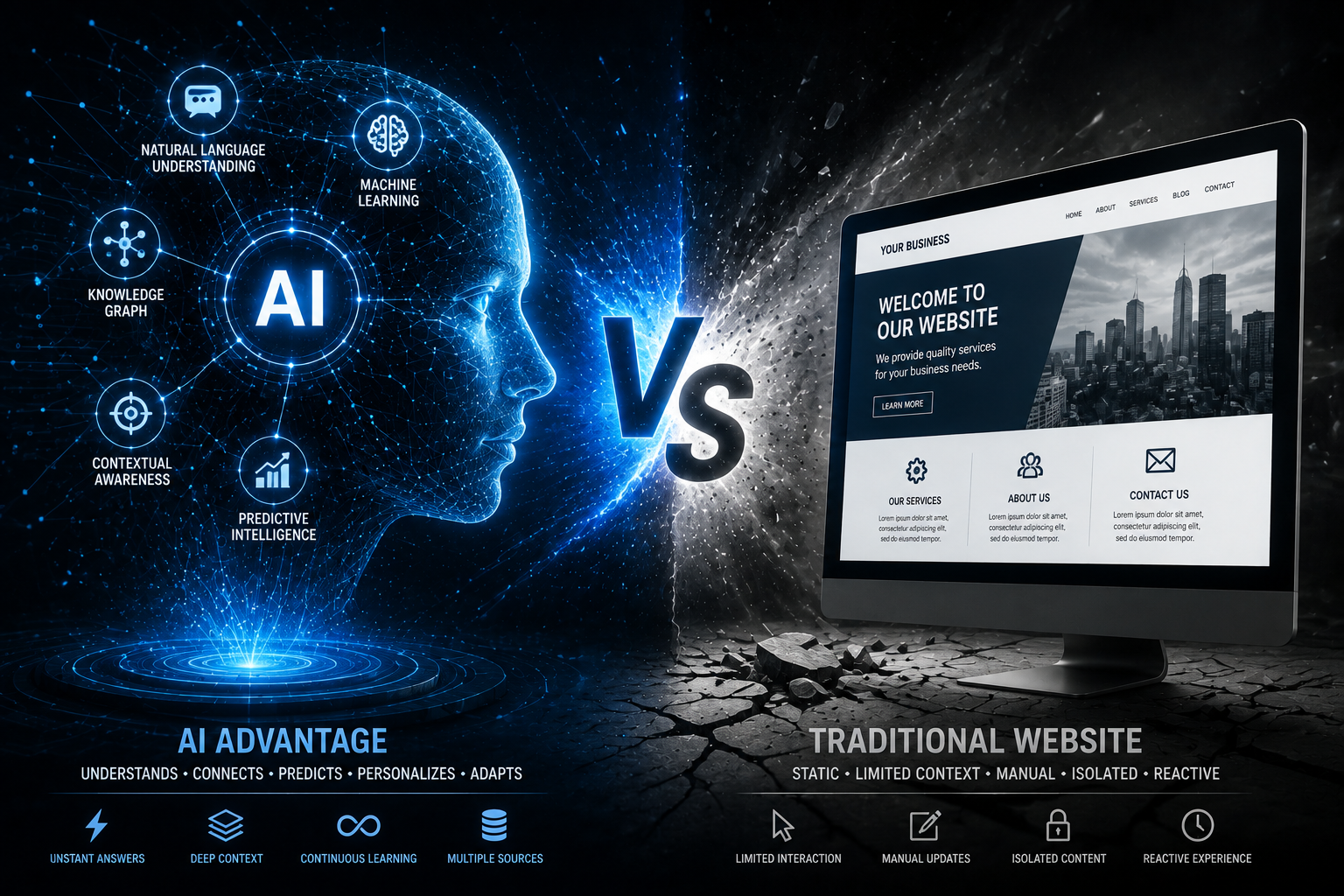
There is a temptation to frame this transition as:
Websites versus AI.
That's the wrong argument.
AI discovery still depends heavily on information originating from the web and other accessible sources.
Google explicitly says its generative AI Search systems use publicly accessible, crawlable content and its Search index to retrieve relevant information.
The better question is:
What kind of website will remain valuable as AI becomes more capable?
The answer is not necessarily the website with the most pages.
Or the website publishing the most often.
Or even the website ranking first for the largest number of generic keywords.
It may increasingly be the organization that consistently provides the clearest combination of:
expertise + evidence + usefulness + trust + accessibility + actionability.
Do People click on Business links in Google
From Digital Brochure to Authority Engine
The traditional business website was built to exist online.
The modern Digital Authority Hub is built to participate in discovery.
It teaches.
It proves.
It connects.
It validates.
It converts.
And, ideally, it contributes knowledge worth finding in the first place.
This requires businesses to think beyond individual pages and campaigns.
Instead, they need to build systems.
A technically strong website.
Clear entity signals.
Deep subject-matter resources.
Firsthand expertise.
Trust evidence.
Question-driven answers.
Strategic internal links.
Strong conversion architecture.
And an external digital presence that reinforces the organization's identity and expertise.
That is the difference between a website people can visit and an authority ecosystem people can discover, understand, trust, and choose.
The Next Question: How Do We Optimize for Humans, Google, and AI at the Same Time?

Once a business begins building an Authority Engine, the next challenge becomes optimization.
Should content be written differently for AI?
Does traditional SEO still matter?
How should keywords and conversational questions work together?
What role do structured data, entities, internal links, images, video, and firsthand expertise play?
And how do businesses optimize for intelligent systems without destroying the experience for actual human beings?
That brings us to the next article in the Pilgrim Digital Authority Series:
The New SEO: How to Optimize for Humans, Google, and AI at the Same Time
ADA-Compliant Web Design: How Accessibility Gives Your Business a Competitive Edge
About Pilgrim Consulting & Design
At Pilgrim Consulting & Design, we don't believe the future of digital marketing is about chasing every new algorithm, platform, or AI shortcut.
It is about building durable digital assets.
That means connecting website strategy, technical SEO, authoritative content, AI discovery, branding, social platforms, email, reputation, customer experience, and conversion strategy into a system that works together.
The goal isn't simply to help a business get another click.
It is to make the business easier to discover, understand, trust, remember, and choose.
Is Your Website Still a Brochure—or Is It Becoming an Authority Engine?
If your company is publishing content, investing in SEO, spending money on advertising, or trying to increase online visibility without seeing the results you expect, the problem may not be another campaign.
It may be the digital foundation underneath everything else.
Talk with Pilgrim Consulting & Design about building a Digital Authority Hub designed for the way customers search, research, evaluate, and make decisions today.
☎️Contact
Frequently Asked Questions
1. What is a Digital Authority Hub?
A Digital Authority Hub is an interconnected website and content ecosystem designed to demonstrate a company's expertise, answer important customer questions, establish trust, strengthen search and AI discoverability, and convert informed visitors into customers. Unlike a traditional website that primarily describes products or services, an authority hub continuously develops useful knowledge around the problems the organization solves.
2. What is the difference between a traditional website and a Digital Authority Engine?
A traditional business website typically focuses on presenting company information, services, and contact options. A Digital Authority Engine goes further by organizing expertise into connected topic clusters, answering customer questions, providing firsthand evidence, building trust signals, strengthening entity clarity, and making that information accessible to both people and search systems.
3. Does AI search make traditional SEO obsolete?
No. Google's guidance states that foundational SEO continues to apply to generative AI features such as AI Overviews and AI Mode. Crawlability, indexing, page experience, useful content, internal linking, technical structure, and search eligibility remain important. AI search expands the discovery environment rather than eliminating traditional SEO.
4. How does a business build topical authority?
Topical authority is developed by creating comprehensive, interconnected resources around a company's genuine areas of expertise. Instead of publishing unrelated articles, businesses can create pillar resources supported by content addressing customer questions, problems, comparisons, processes, misconceptions, case studies, and related services. Strategic internal linking helps connect those resources into a coherent knowledge system.
5. Why is firsthand experience important for AI search?
Firsthand experience provides information that generic content cannot easily reproduce. Customer observations, proprietary processes, case studies, benchmarks, expert opinions, field data, failure patterns, and original research can differentiate a company's content. Google specifically encourages unique, non-commodity content and firsthand perspectives in its guidance for generative AI search.
6. What are entity signals?
Entity signals are pieces of information that help digital systems understand who a business is and how it relates to particular people, locations, industries, products, services, and topics. Business profiles, directories, reviews, social accounts, professional biographies, publications, partnerships, media mentions, and consistent company information can contribute to stronger entity clarity.
7. Why is internal linking important for digital authority?
Internal linking helps visitors and search systems understand how different topics and pages relate to one another. It can connect supporting articles to pillar resources, educational pages to services, related questions to deeper information, and authoritative content to conversion opportunities. A strong internal-linking structure turns isolated pages into a connected knowledge architecture.
8. Should businesses still invest in advertising if they are building digital authority?
Yes, when advertising supports a sound strategy. Digital authority and advertising serve different purposes. Advertising can generate immediate visibility, while authoritative content and organic visibility can build longer-term digital assets. Businesses often perform better when paid promotion sends prospects into a strong digital environment rather than compensating for a weak one.
9. How long does it take to build digital authority?
There is no universal timeline. Results depend on competition, market size, existing website strength, technical condition, content quality, local relevance, authority, and the consistency of execution. Some businesses may see meaningful improvements relatively quickly, while competitive markets may require sustained development over many months or longer.
10. How should a business measure digital authority?
Businesses should look beyond raw website traffic. Useful indicators may include search impressions, visibility for important customer questions, branded searches, qualified leads, conversion rate, local visibility, engagement with authoritative content, third-party mentions, backlinks, returning visitors, lead quality, and visibility within AI-assisted search experiences as reliable measurement becomes available.
Previous Article: AI Search & the New Customer Journey | Pilgrim Consulting
Next Article: