
The Website Most Businesses Built in The Early 2000 Is No Longer Enough
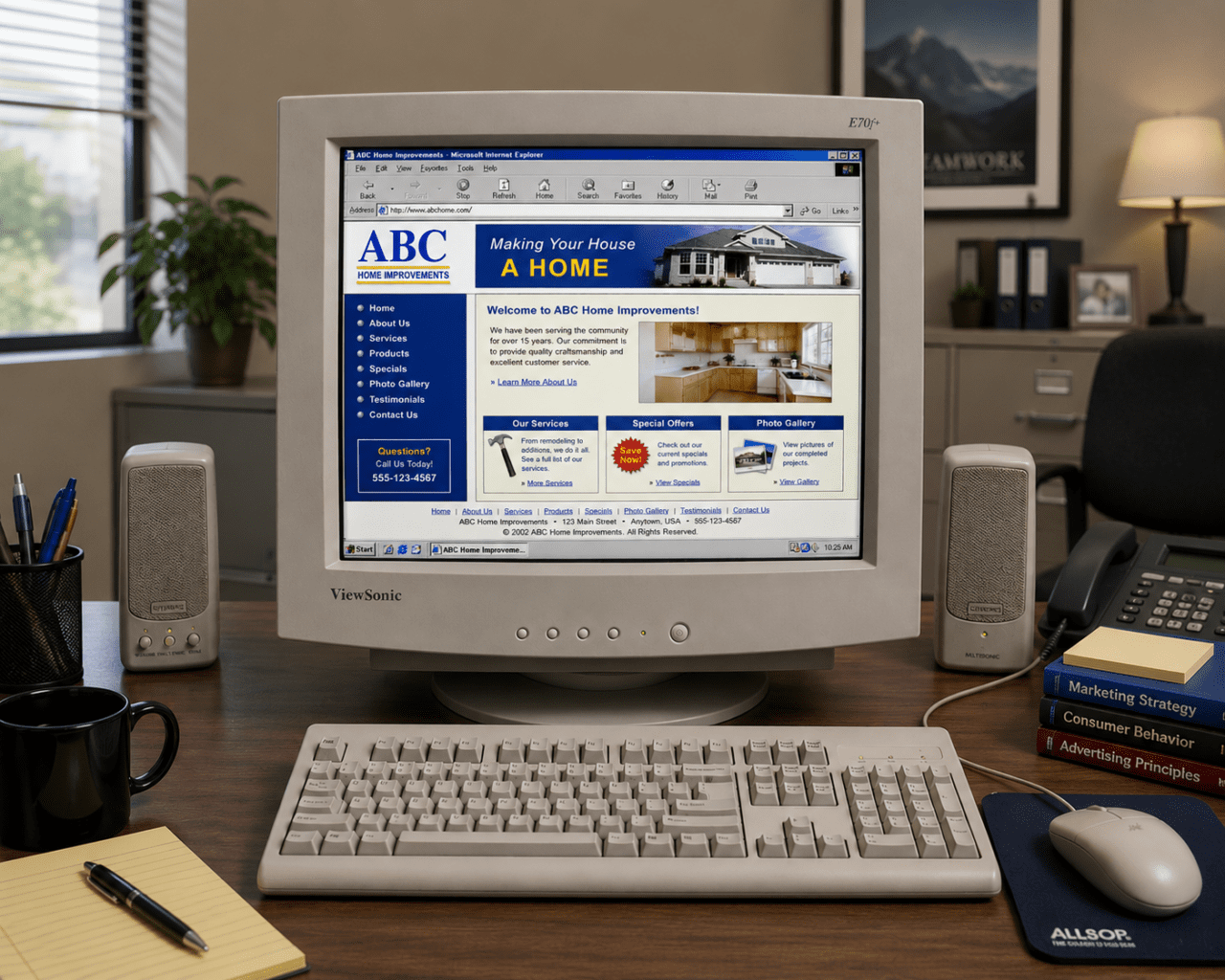
For decades, the standard business website followed a familiar formula:
- Home Page
- About Page
- Services Page
- Contact Page
Maybe a few photos.
Maybe a blog nobody updates.
And for years, that was enough.
But search has changed.
Consumer behavior has changed.
Artificial intelligence has changed.
The website that once generated leads and visibility is now becoming increasingly invisible in a world driven by AI-powered discovery.
The harsh reality?
Many business websites today are not broken.
They're simply outdated.
👉🏻Web Design Services
Search Is No Longer Looking for Websites

This may be the biggest shift businesses need to understand.
Consumers are no longer searching the way they did ten years ago.
Instead of typing:
"commercial cleaning Bangor Maine"
Consumers increasingly ask:
- Who is the best commercial cleaning company near me?
- What odor removal company should I trust?
- What's the best HVAC system for my home?
- Who offers mini skid steers in New England?
These aren't keyword searches.
They're conversations.
And AI systems respond differently than traditional search engines.
Rather than simply finding websites, AI looks for trusted sources capable of providing answers.
This fundamentally changes how businesses must approach their websites.
Also Read 🖥️Why SEO Matters More Than Ever in the AI Visibility Era
The Rise of the Digital Authority Hub
The future website is not a brochure.
It's a knowledge center.
It's a resource library.
It's a trust-building platform.
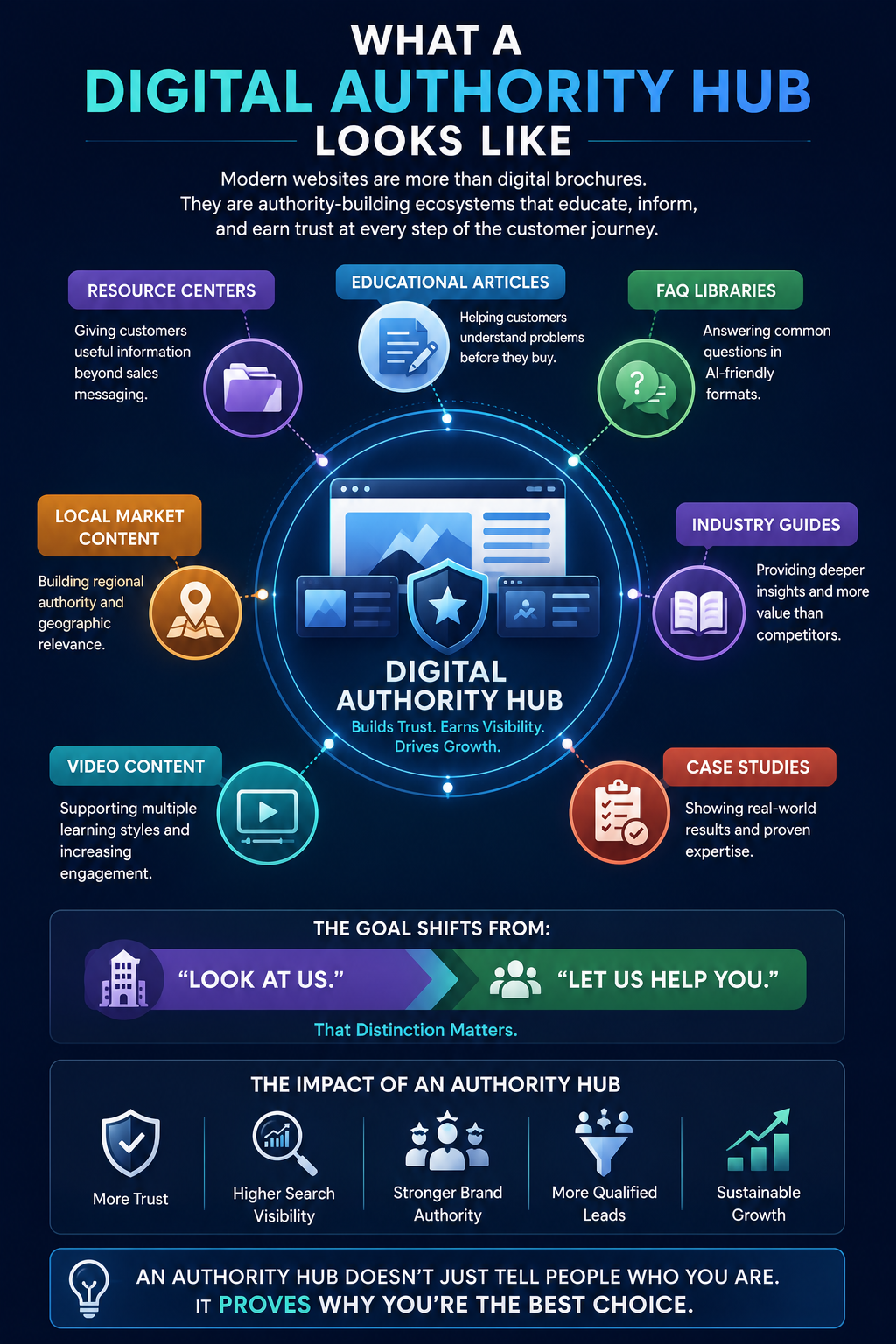
It's a digital authority hub.
A digital authority hub doesn't just tell visitors what a company does.
It proves expertise.
It answers questions.
It educates customers.
It demonstrates authority.
Also read 🖥️How AI Reshapes Executive Decision-Making Without Replacing Leadership in 2026
Why AI Loves Authority Hubs
AI systems prioritize trust.
And trust is built through evidence.
AI increasingly evaluates:
✅ Expertise
✅ Consistency
✅ Topical depth
✅ Structured information
✅ User value
A five-page brochure website provides very little evidence.
An authority hub provides hundreds of signals demonstrating expertise.
This is why AI visibility increasingly favors businesses that teach rather than simply advertise.
Also Read 🖥️Why Are AI Governance and Ethics Competitive Advantages Today?
Service Business Scenario
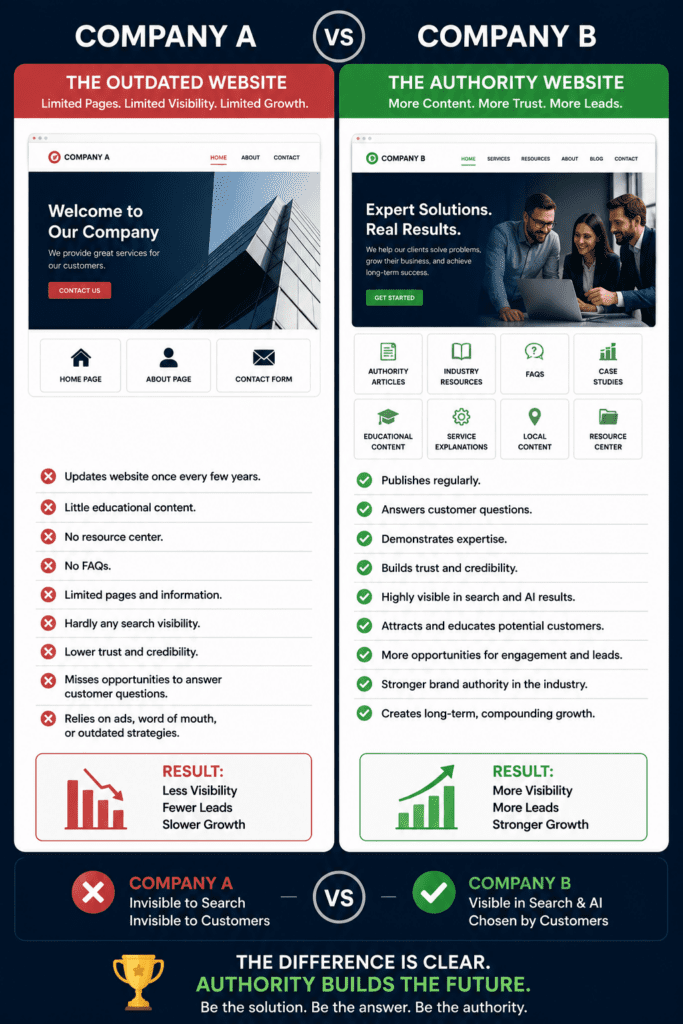
Let's compare two companies.
Company A
Website contains:
- Home Page
- About Page
- Contact Form
Updates website once every few years.
Little educational content.
No resource center.
No FAQs.
Company B
Website contains:
- Authority articles
- Industry resources
- FAQs
- Case studies
- Educational content
- Service explanations
- Local content
Publishes regularly.
Answers customer questions.
Demonstrates expertise.
Which company is more likely to be referenced by:
- Google AI Overviews?
- ChatGPT recommendations?
- Voice assistants?
- Future AI search systems?
The answer is obvious.
Company B becomes the authority.
Company A becomes invisible.
👉🏻Business Operations Analysis
Modern SEO Is Becoming Digital Authority Building
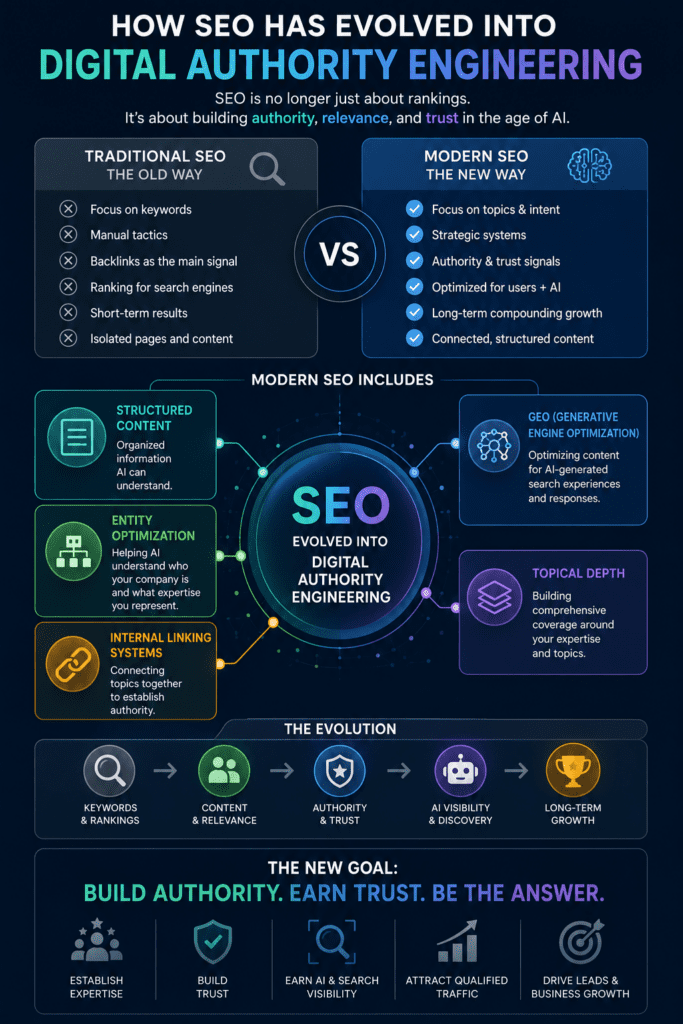
Many businesses still think SEO means:
Keywords.
Meta descriptions.
Backlinks.
Those still matter.
But they're only part of the picture.
Modern SEO now includes:
Structured Content
Organized information AI can understand.
Entity Optimization
Helping AI understand who your company is and what expertise you represent.
Internal Linking Systems
Connecting topics together to establish authority.
GEO (Generative Engine Optimization)
Optimizing content for AI-generated search experiences.
Topical Depth
Building comprehensive coverage around your expertise.
SEO is evolving into something larger:
Digital Authority Engineering.
👉🏻Organic SEO Support
Why Most Businesses Struggle to Make This Transition
This is where many companies get stuck.
Business owners understand they need:
- Better SEO
- Better content
- Better visibility
But they underestimate the complexity.
Building an authority hub requires:
- Content strategy
- Website architecture
- SEO expertise
- GEO optimization
- AI visibility understanding
- Consistent publishing
- Technical implementation
And most business owners are already busy running their companies.
Also Read 🖥️The Pilgrim Advantage – Streamline, Optimize, and Supercharge Service Businesses
The Hidden Cost of Doing It Yourself

One of the biggest misconceptions in digital marketing is:
"We'll just handle it ourselves."
While that sounds practical, it often creates hidden costs.
Businesses attempting DIY authority building frequently face:
❌ Inconsistent publishing
❌ Poor website structure
❌ Weak SEO performance
❌ Missed opportunities
❌ Outdated strategies
❌ Lost visibility
❌ Wasted time
Most business owners aren't lacking intelligence.
They're lacking time.
And time is often the most expensive resource of all.
Also Read 🖥️DIY Websites vs. Professional Design | Pilgrim Consulting & ADA Compliance
Why Experienced Consulting Partners Matter

The companies winning today aren't trying to master every aspect of digital visibility internally.
Instead, they work with experienced partners who understand:
- SEO strategy
- AI visibility
- GEO optimization
- Content systems
- Website architecture
- Lead generation
- Authority building
A qualified consulting partner helps businesses:
✅ Avoid expensive mistakes
✅ Accelerate implementation
✅ Focus on proven strategies
✅ Stay ahead of AI-driven changes
✅ Build sustainable visibility systems
The goal isn't to become an SEO expert.
The goal is to grow your business.
Also Read🖥️ Social Media Management & Interface Strategy for Maine Businesses
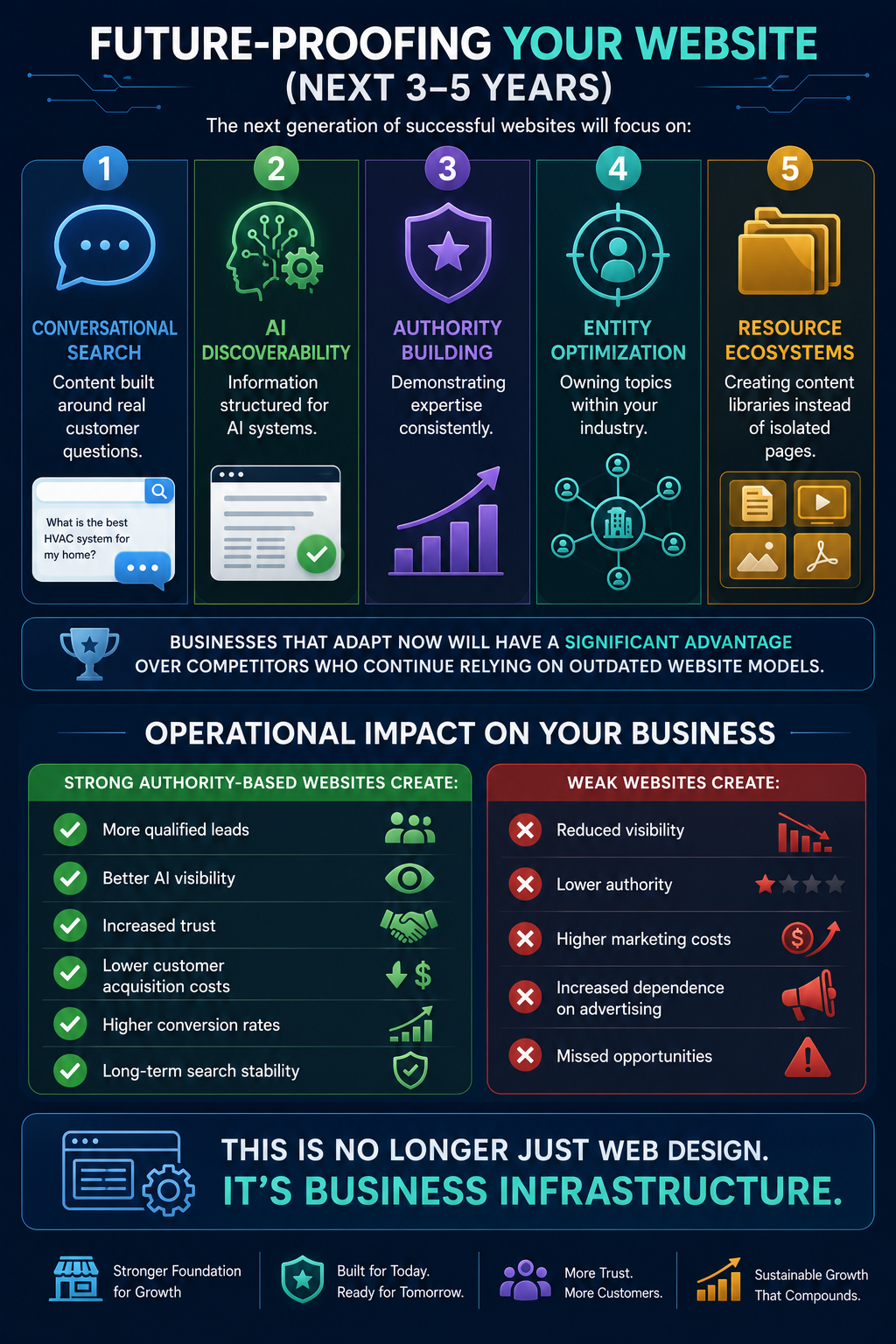
Summing It Up
The traditional business website is not completely dead.
But it is no longer enough.
Businesses that continue treating their websites as online brochures will struggle to compete in an AI-driven search environment.
The future belongs to companies that transform their websites into digital authority hubs.
Because search is changing.
Consumers are changing.
AI is changing.
And visibility is becoming the most valuable asset a business can own.
Give Us A Call
If your website still functions like a digital brochure, now is the time to rethink its role in your business growth strategy.
Pilgrim Consulting & Design helps businesses transform outdated websites into authority-building ecosystems designed for modern SEO, AI visibility, lead generation, and long-term growth.
The future of visibility isn't coming.
It's already here.
📞Contact
🏡Home
FAQS
1. What is a Digital Authority Hub?
A Digital Authority Hub is a website designed to educate, inform, and build trust rather than simply promote products or services. It combines authority articles, FAQs, case studies, educational resources, videos, local content, and industry insights into a connected ecosystem that helps customers find answers while establishing your business as a trusted expert.
2. Why are traditional business websites becoming less effective?
Traditional websites were built primarily as online brochures with a Home Page, About Page, Services Page, and Contact Form. Today's consumers and AI search systems expect much more. Businesses that fail to provide educational content, FAQs, resources, and expertise-driven information often struggle to gain visibility and trust compared to competitors that actively publish valuable content.
3. How does AI impact website visibility?
AI-powered search tools such as Google AI Overviews, ChatGPT, Gemini, and voice assistants increasingly prioritize websites that demonstrate expertise, authority, and topical depth. Websites with structured content, helpful resources, and clear expertise signals are more likely to be referenced by AI systems than static websites with limited information.
4. What is Generative Engine Optimization (GEO)?
Generative Engine Optimization (GEO) is the practice of optimizing content for AI-generated search experiences. Unlike traditional SEO, which focuses primarily on rankings, GEO focuses on making content easier for AI systems to understand, reference, and recommend through structured information, semantic relevance, authority signals, and conversational content formats.
5. Why is content more important than ever for SEO?
Content serves as proof of expertise. Search engines and AI systems use content to determine whether a business understands its industry and can provide trustworthy information. Educational articles, FAQs, guides, case studies, and resource centers help establish authority while creating more opportunities for customers to discover your business.
6. How often should businesses publish content?
Consistency matters more than frequency. Many successful businesses publish one to four high-quality pieces of content per month. The key is maintaining a steady publishing schedule that answers customer questions, demonstrates expertise, and expands topical authority over time.
7. Can small businesses compete with larger companies using authority content?
Absolutely. One of the advantages of authority-based SEO is that expertise often outweighs company size. Small businesses that consistently create helpful, locally relevant, and industry-specific content can outperform larger competitors that rely solely on brand recognition or advertising budgets.
8. What is the difference between SEO and Digital Authority Building?
Traditional SEO focused heavily on rankings, keywords, and backlinks. Digital Authority Building expands on SEO by incorporating content strategy, AI visibility, trust signals, entity optimization, user experience, topical depth, and expertise development. The goal is not simply to rank but to become a recognized authority within your industry.
9. Is DIY SEO still realistic for most business owners?
While business owners can learn basic SEO principles, modern SEO has become increasingly complex. Today's visibility strategies often require expertise in content development, technical SEO, schema markup, AI optimization, GEO, website architecture, analytics, and conversion optimization. Many businesses find greater success working with experienced consultants who can guide and implement these systems efficiently.
10. Why should businesses work with a consulting partner for SEO and AI visibility?
A qualified consulting partner helps businesses avoid costly mistakes, stay current with evolving search technologies, implement proven strategies, and build long-term authority systems. Instead of spending years learning SEO, AI visibility, GEO, and content strategy internally, businesses can leverage expert guidance to accelerate growth, improve discoverability, and future-proof their digital presence.