
Your Website Isn’t the Destination Anymore: How AI Search Is Changing the Customer Journey
Executive Summary
Estimated Reading Time: 60 Sec
For more than two decades, digital marketing operated around a relatively simple assumption: get people to the website.
Businesses invested in search engine optimization, paid advertising, social media, email marketing, and content because the website was considered the destination—the place where prospects would finally learn about the company, compare options, build trust, and decide what to do next.
That model is changing.
Artificial intelligence is increasingly moving discovery, research, comparison, and even early-stage decision-making upstream of the website.
Google AI Overviews and AI Mode can synthesize information from multiple sources. ChatGPT Search can answer questions conversationally while citing web sources. Other AI-powered discovery systems are following similar patterns.
The result is a fundamental change in the customer journey:
Customers may form an opinion about your company before they ever visit your website.
That does not make websites less important. It changes what successful websites must accomplish.
The businesses positioned to succeed in this environment will increasingly need digital ecosystems that accomplish two jobs simultaneously:
- Provide exceptional information and experiences for human visitors.
- Create clear, trustworthy, structured evidence that search engines and AI systems can understand, retrieve, contextualize, and potentially cite.
The strategic question is therefore changing from:
“How do we get more people to our website?”
to:
“How do we become one of the trusted sources people—and the systems helping them make decisions—discover along the way?”
Read More
Full Article | Estimated Reading Time: 14–16 Minutes
⬇️⬇️⬇️⬇️
The Website Was Never Really the Goal
For years, businesses have measured digital marketing success using familiar metrics:
- Google rankings
- website sessions
- page views
- click-through rates
- bounce rates
- form submissions
- phone calls
- conversions
Those metrics still matter.
But they were created around an internet where discovering information usually required clicking through to a webpage.
A customer might search:
“Best IT company for a small business near me.”
Google returned links.
The customer opened several websites.
They compared services, read testimonials, checked credentials, and eventually contacted a company.
The website served as the primary research environment.
Now imagine the same customer asking an AI system:
“I own a 40-person manufacturing company. What should I look for in an IT provider that can handle cybersecurity, Microsoft 365, compliance, and long-term technology planning?”
That is not simply a keyword.
It is a conversation.
And the AI system may assemble an answer using information from multiple sources before the customer ever visits any of them.
That distinction changes digital strategy.
Also Read 💻The AI Trust Economy: Why Authority Is Replacing Advertising
Search Is Becoming a Conversation

Traditional search was largely built around retrieval.
You typed a query.
The search engine returned a collection of pages that might contain the answer.
You did the research.
AI-assisted search increasingly performs part of that research for you.
Google reported in May 2026 that AI Mode had surpassed one billion monthly active users globally, while AI Mode queries had more than doubled every quarter since launch. Google also says people are using these tools to ask longer and more complicated questions than they traditionally asked search engines.
That matters because the interface is changing from:
QUERY → LINKS → WEBSITE → RESEARCH → DECISION
toward something closer to:
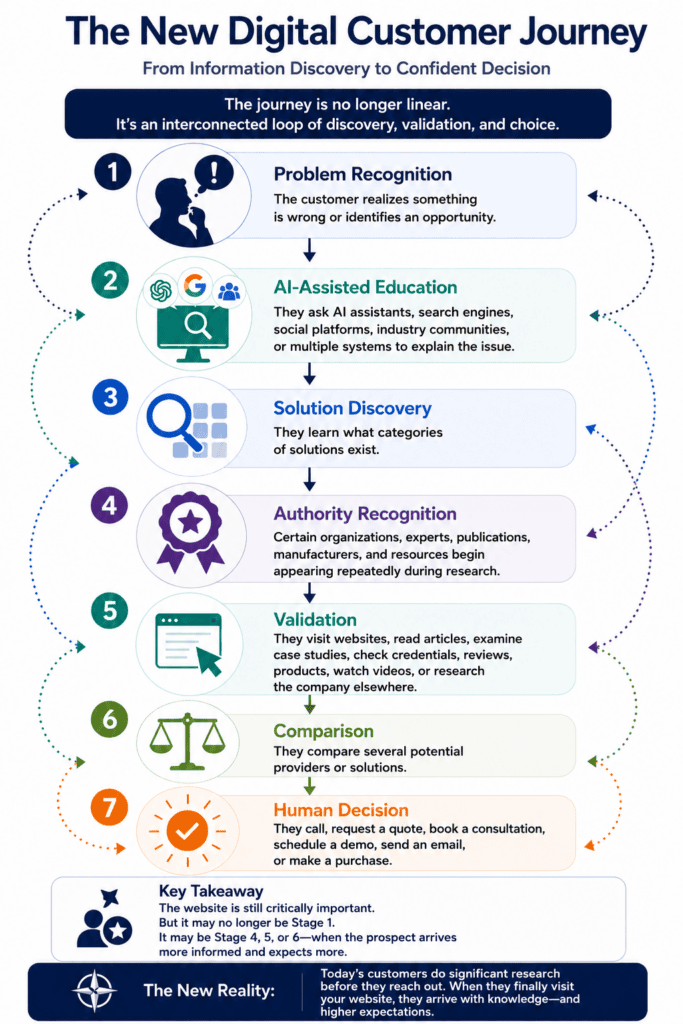
QUESTION → SYNTHESIZED ANSWER → FOLLOW-UP QUESTIONS → SOURCE VALIDATION → DECISION
The website has not disappeared from that journey.
It has moved.
In many cases, the website becomes the evidence layer underneath the answer and the validation layer a prospect visits after substantial research has already occurred.
That is an enormous distinction.
Also Read 💻Why SEO Matters More Than Ever in the AI Visibility Era
The Data Shows That Customer Behavior Is Already Changing
This shift is not theoretical.
Pew Research Center analyzed the browsing behavior associated with 68,879 Google searches and found that roughly 18% of the searches examined produced an AI-generated summary.
The behavior following those searches was particularly interesting.
When an AI summary appeared, users clicked a traditional search result in only 8% of visits.
When no AI summary appeared, users clicked traditional results in approximately 15% of visits.
Clicks directly on sources cited within AI summaries occurred in only about 1% of visits containing an AI summary.
Another 2026 Pew survey found that 60% of U.S. adults say they read AI summaries at the top of search results at least sometimes.
Those numbers point toward an important change.
Visibility can no longer be measured by clicks alone.
A company could influence a buying decision without receiving the first click.
Its research could inform an AI-generated explanation.
Its terminology could shape the conversation.
Its expertise could help establish what the buyer believes constitutes a good solution.
Its brand might appear as a source during the research process.
This creates a new category of marketing value:
Influence Before Visit.
Web Design Services
The Zero-Click Customer Journey
Marketers have discussed “zero-click searches” for years.
AI accelerates the concept.
Consider someone researching commercial cleaning technology.
Instead of searching:
commercial floor cleaning equipment
they might ask:
“What equipment could help a 500,000-square-foot facility reduce floor maintenance labor without sacrificing consistency?”
That question contains several dimensions:
- facility size
- labor
- productivity
- equipment
- quality
- operational constraints
An AI system can potentially research those concepts simultaneously.
The user can then continue:
“Which approaches require the fewest workers?”
Then:
“What should I ask vendors during a demonstration?”
Then:
“Compare the advantages and disadvantages.”
By the time that prospect reaches a manufacturer's website, they may already understand:
- the problem,
- the terminology,
- available solutions,
- potential tradeoffs,
- questions to ask,
- and characteristics they should compare.
The website visitor arriving from this journey is fundamentally different from the website visitor of ten years ago.
They may be farther down the decision funnel.
Also Read 💻Why SEO Matters More Than Ever in the AI Visibility Era
Your Website Is Becoming a Source, Not Just a Destination

This is one of the most important strategic changes businesses need to understand.
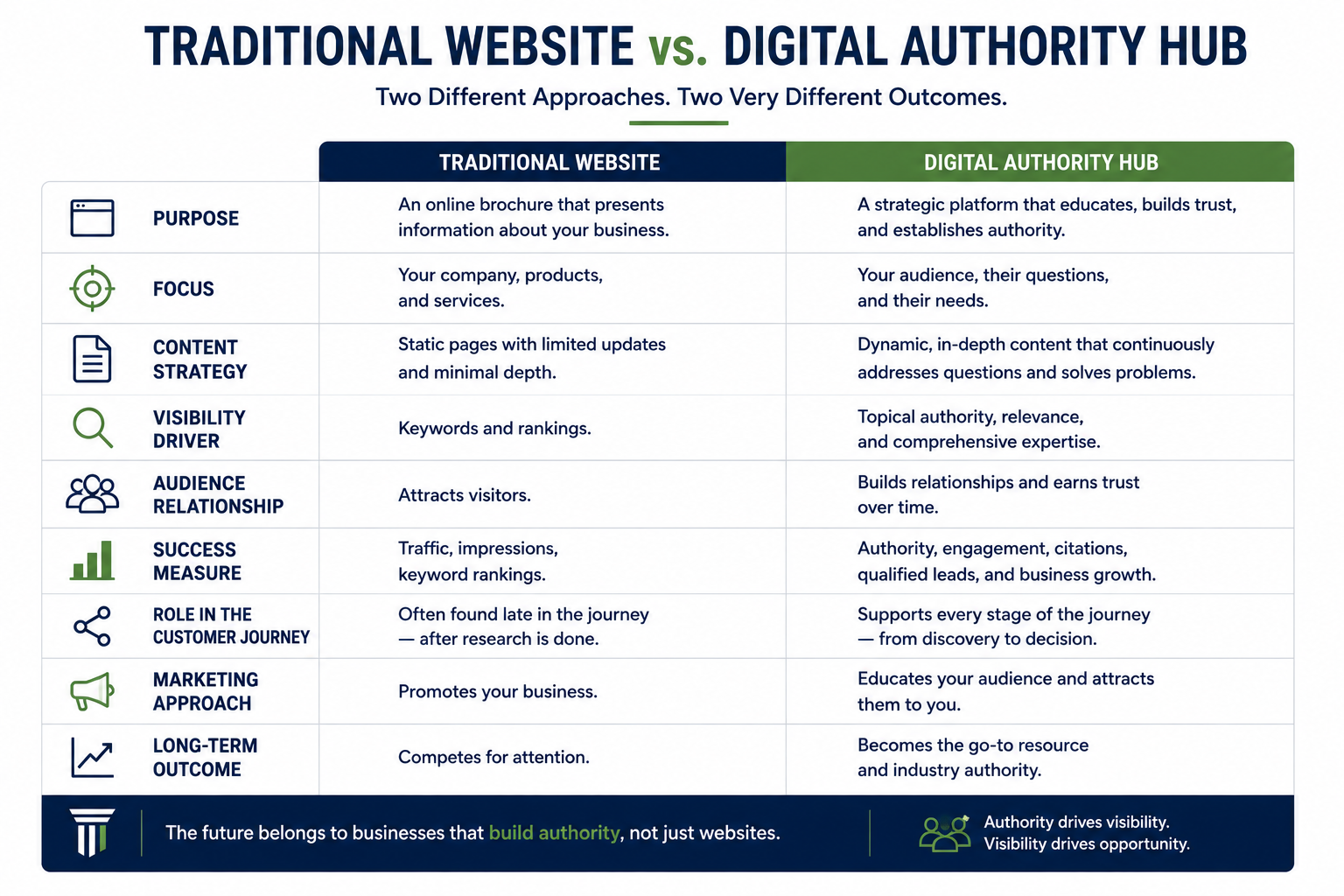
A traditional website was designed primarily to convince visitors.
An authority website must do something more.
It needs to become a reliable source of knowledge about the problems the company solves.
That means the content cannot consist entirely of:
We provide outstanding service.
We care about our customers.
We have decades of experience.
Contact us today.
Those statements may be perfectly true.
But they contribute very little knowledge to the broader information ecosystem.
AI systems and search engines need substantive information to understand what a company actually knows.
A stronger website answers questions such as:
- What causes this problem?
- How is it diagnosed?
- What solutions exist?
- What are the tradeoffs?
- What does the process involve?
- What mistakes should customers avoid?
- When should someone call a professional?
- How much can the problem affect operations?
- How should competing solutions be evaluated?
- What terminology does the industry use?
- What evidence supports the recommended approach?
Every meaningful answer adds another piece to the company's digital knowledge footprint.
Also Read 💻Why Traditional Business Websites Are Dying (And What Replaces Them)
Welcome to the Authority Economy
SEO historically asked:
“How can we rank this page?”
The next generation of digital strategy asks a larger question:
“How can we make this organization recognizable as an authority on this subject?”
That distinction matters.
One highly optimized page may rank for a keyword.
But genuine authority usually comes from an interconnected body of useful information.
Imagine a company specializing in indoor air quality.
Its website might contain authoritative resources explaining:
- indoor air pollutants
- mold
- humidity
- VOCs
- ventilation
- odor chemistry
- HVAC contamination
- moisture intrusion
- particulate matter
- testing
- remediation
- prevention
Now compare that with a competitor whose website contains:
Home | About | Services | Contact
Both businesses may offer similar services.
But digitally, they are not communicating the same depth of expertise.
The first has created a knowledge ecosystem.
The second has created a brochure.
That difference is becoming increasingly important.
Also Read 💻The AI Trust Economy: Why Authority Is Replacing Advertising
AI Visibility Is Not a Magic New SEO Trick
There is already an industry emerging around terms such as:
- Generative Engine Optimization (GEO)
- Answer Engine Optimization (AEO)
- AI SEO
- LLM optimization
- AI visibility optimization
Some of these concepts are useful.
But businesses should be careful about anyone claiming to possess a secret formula for “ranking in AI.”
Google's own guidance is refreshingly straightforward.
Google says there are no special technical requirements for appearing as a supporting link in AI Overviews or AI Mode beyond being eligible for Google Search. Its recommendation remains centered on solid technical SEO and helpful, reliable, people-first content.
That does not mean businesses should ignore AI discovery.
It means the fundamentals are becoming more important—not less.
Useful information.
Clear structure.
Demonstrated expertise.
Technical accessibility.
Original insight.
Trust.
Context.
Authority.
These are not shortcuts.
They are assets.
Organic SEO Support
The Most Valuable Traffic May Become Smaller but Better
This creates an interesting possibility for marketers.
For years, businesses chased traffic volume.
10,000 visitors must be better than 5,000.
Not necessarily.
Imagine one website receives 10,000 visitors who are beginning their research.
Another receives 5,000 visitors who have already spent considerable time researching the problem through AI-assisted search.
The second audience could potentially be:
-
- better educated,
- more problem-aware,
- more solution-aware,
- more skeptical,
- more comparison-oriented,
- and closer to making a decision.
That changes the value of the session.
The future KPI may not simply be:
How many people visited?
It may increasingly become:
How much authority did we build before they arrived—and how effectively did the website convert that authority once they did?
Also Read 💻How Can AI Content Audits Preserve Brand Voice in a 2026 AI-Driven Market?
What Businesses Should Be Building Now
Businesses do not need to throw away everything they know about digital marketing.
They need to expand the model.
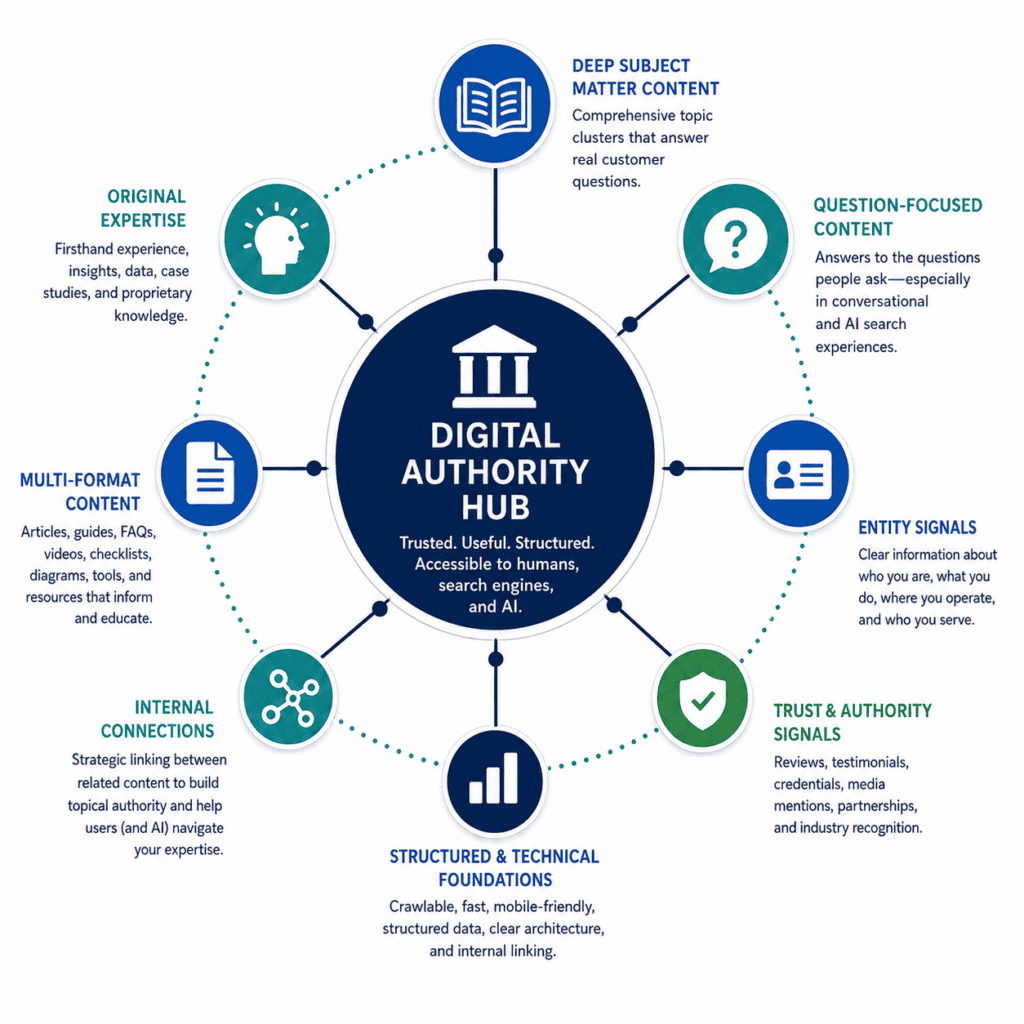
A modern digital authority system should include several interconnected layers.
The Pilgrim Digital Authority Framework™
Knowing the individual components of digital authority is important. Understanding how they work together is where strategy begins.
At Pilgrim Consulting & Design, we organize these principles into what we call the Pilgrim Digital Authority Framework™—a seven-layer model for building a digital presence that can be understood by people, search engines, and AI-powered discovery systems while still accomplishing the ultimate business objective: turning authority into action.
The framework is built around seven interconnected layers.
1. Technical Accessibility
Can search engines and AI-powered discovery systems reliably access, interpret, and retrieve your information?
Authority begins with infrastructure.
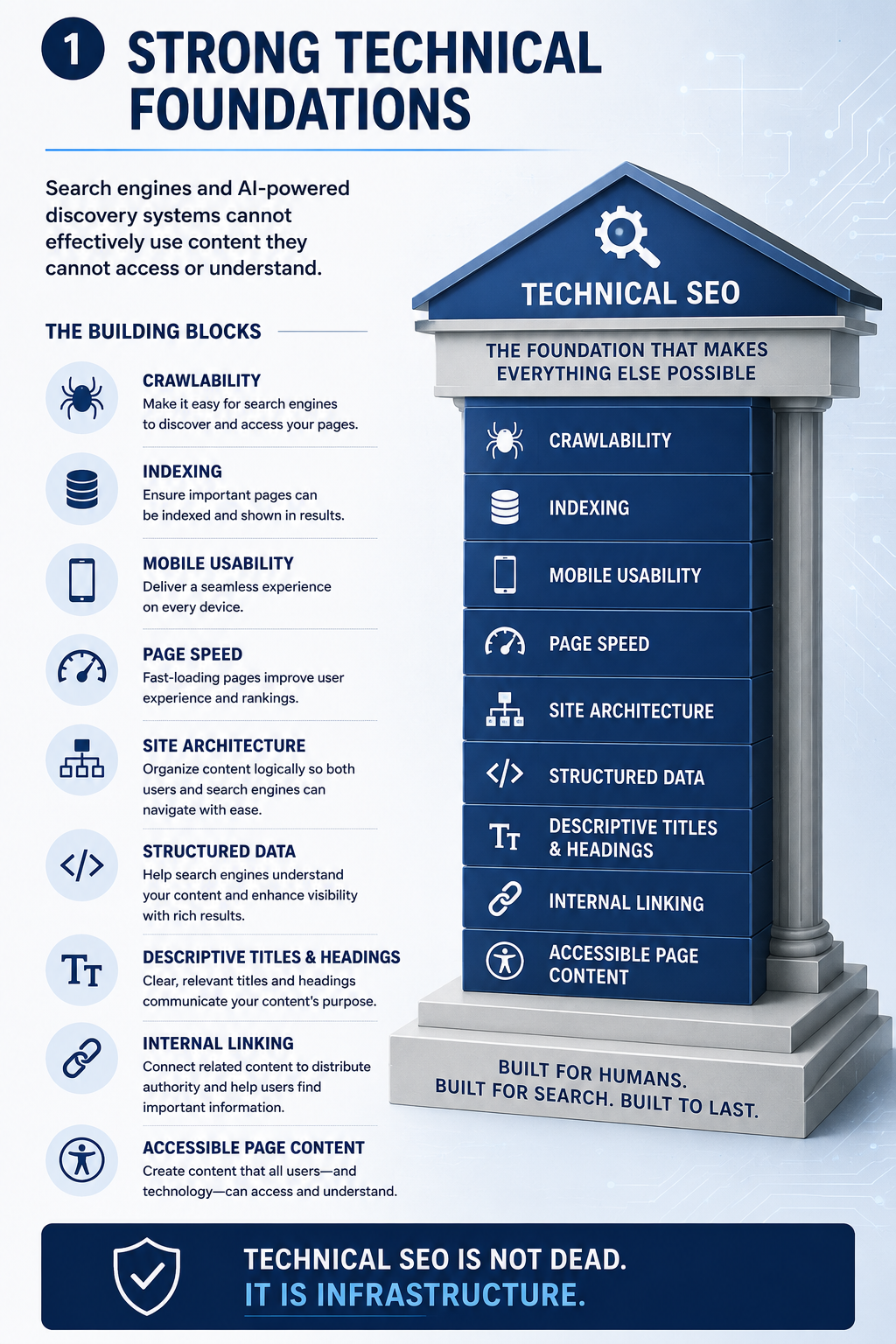
A website needs to be crawlable, indexable, mobile-friendly, logically structured, fast, internally connected, and technically accessible. Appropriate structured data can provide additional context about pages, organizations, products, services, people, and other entities.
Excellent information has limited digital value when the systems responsible for discovering it cannot reliably access or understand it.
Foundation: Make the knowledge accessible.
2. Entity Clarity
Can digital systems clearly understand who you are and what your organization represents?
Your company should have a consistent digital identity.
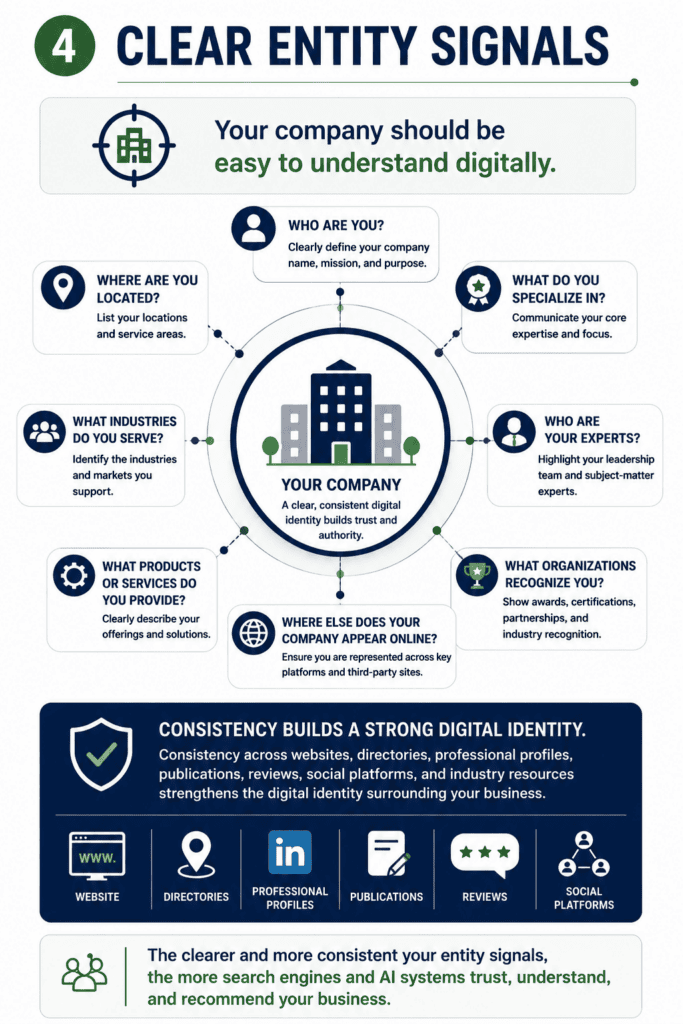
Business name, location, expertise, services, leadership, industries served, professional profiles, directory listings, reviews, media references, certifications, partnerships, and other third-party signals collectively help establish that identity.
The objective is consistency.
Search and AI systems should encounter a coherent representation of the organization wherever it appears.
Foundation: Make the organization understandable.
3. Knowledge Depth
Does your digital presence demonstrate genuine depth around the subjects your company claims to understand?
One article does not create authority.
Neither does publishing unrelated blog posts simply to target keywords.
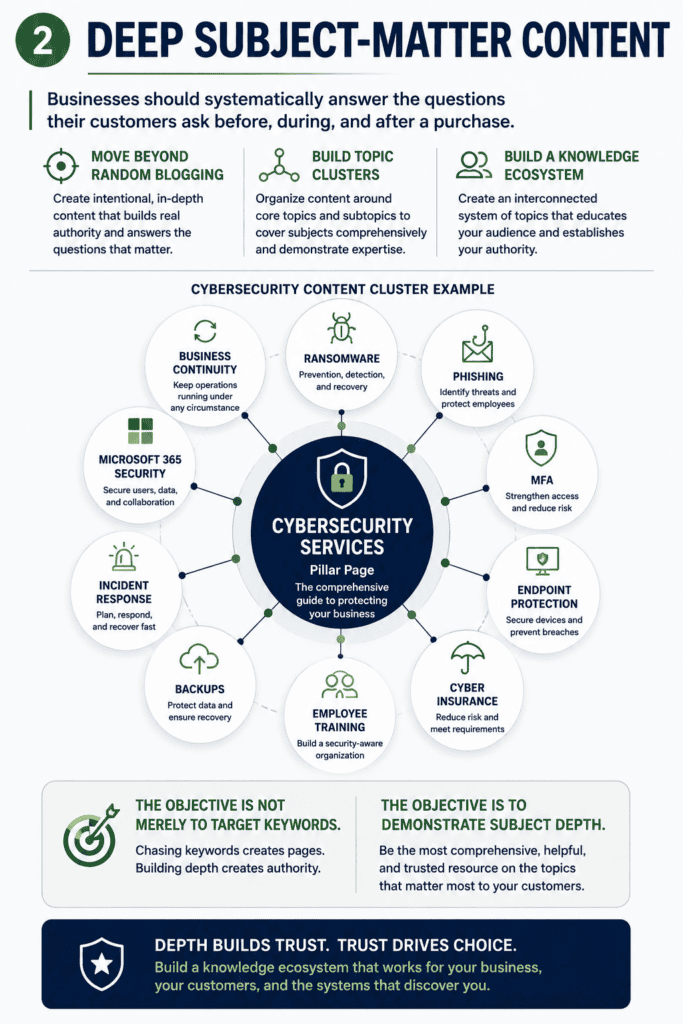
Businesses should develop interconnected knowledge ecosystems around their areas of expertise—answering customer questions, explaining problems, comparing approaches, defining terminology, examining misconceptions, documenting solutions, and connecting related subjects through thoughtful internal linking.
The goal is not simply more content.
It is demonstrable subject depth.
Foundation: Make the expertise visible.
4. Firsthand Evidence
Are you contributing knowledge—or simply repeating information that already exists?
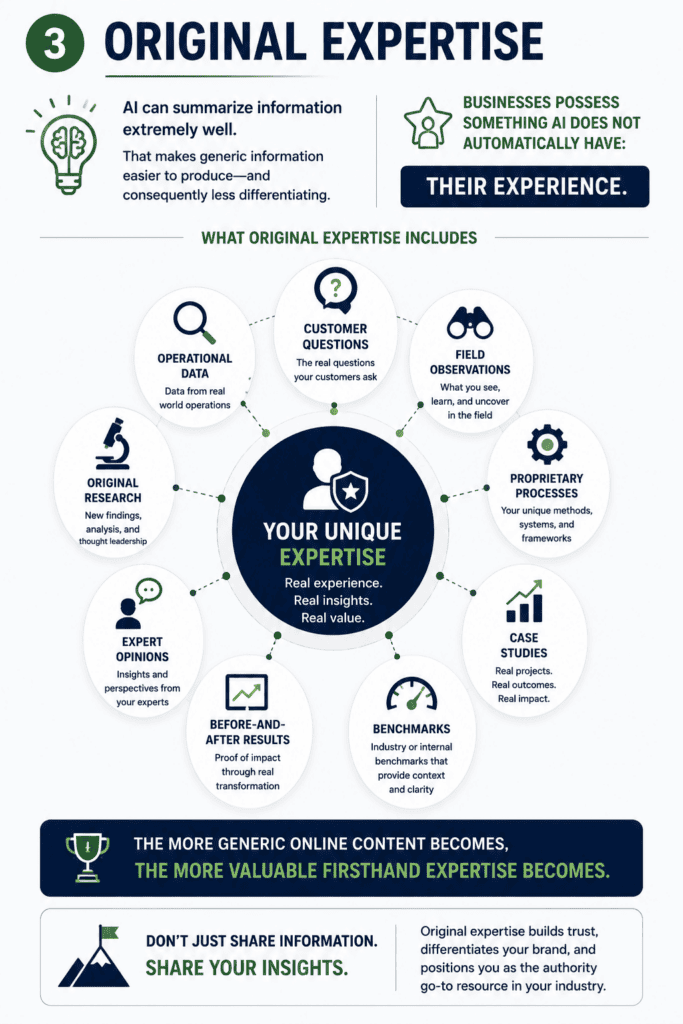
As AI makes generic information increasingly easy to produce, firsthand expertise becomes more valuable.
Customer questions, field observations, case studies, proprietary processes, benchmarks, operational data, before-and-after results, failure patterns, expert perspectives, and original research provide something generic content cannot easily reproduce:
experience.
This is where businesses begin moving from content publishers to genuine knowledge sources.
Foundation: Contribute something worth knowing.
5. Trust Validation
What evidence confirms that your organization deserves to be trusted?
Authority cannot depend entirely on what a company says about itself.
Reviews, testimonials, credentials, certifications, case studies, professional affiliations, partnerships, media coverage, citations, awards, customer outcomes, expert authorship, and independent recognition can help validate expertise.
In an environment filled with increasingly inexpensive content, verifiable trust signals become more important.
Foundation: Prove the authority you claim.
6. Answer Accessibility
Can someone—or an intelligent system—quickly find a clear answer to an important customer question?
Modern customers increasingly search conversationally.
They do not only type keywords.
They ask:
Why is this happening?
Which solution is right for me?
What should this cost?
What are the risks?
How do these options compare?
When should I call a professional?
Content should provide clear, useful, self-contained answers to the questions customers actually ask.
That makes information easier for humans to use and easier for search and AI systems to retrieve within relevant contexts.
Foundation: Become the answer people are looking for.
7. Conversion Readiness
When an informed prospect finally reaches your website, does the experience make the next decision easier?
Digital authority without conversion strategy leaves business value on the table.
AI-assisted customers may arrive at a website significantly farther into their research process than traditional search visitors.
They may already understand the problem.
They may know the terminology.
They may have compared several approaches.
And they may already be evaluating your company against competitors.
The website therefore needs clear calls to action, intuitive navigation, compelling proof, relevant case studies, accessible contact options, transparent next steps, and an experience appropriate for a more informed buyer.
Foundation: Turn earned authority into action.
The Framework Works as a System
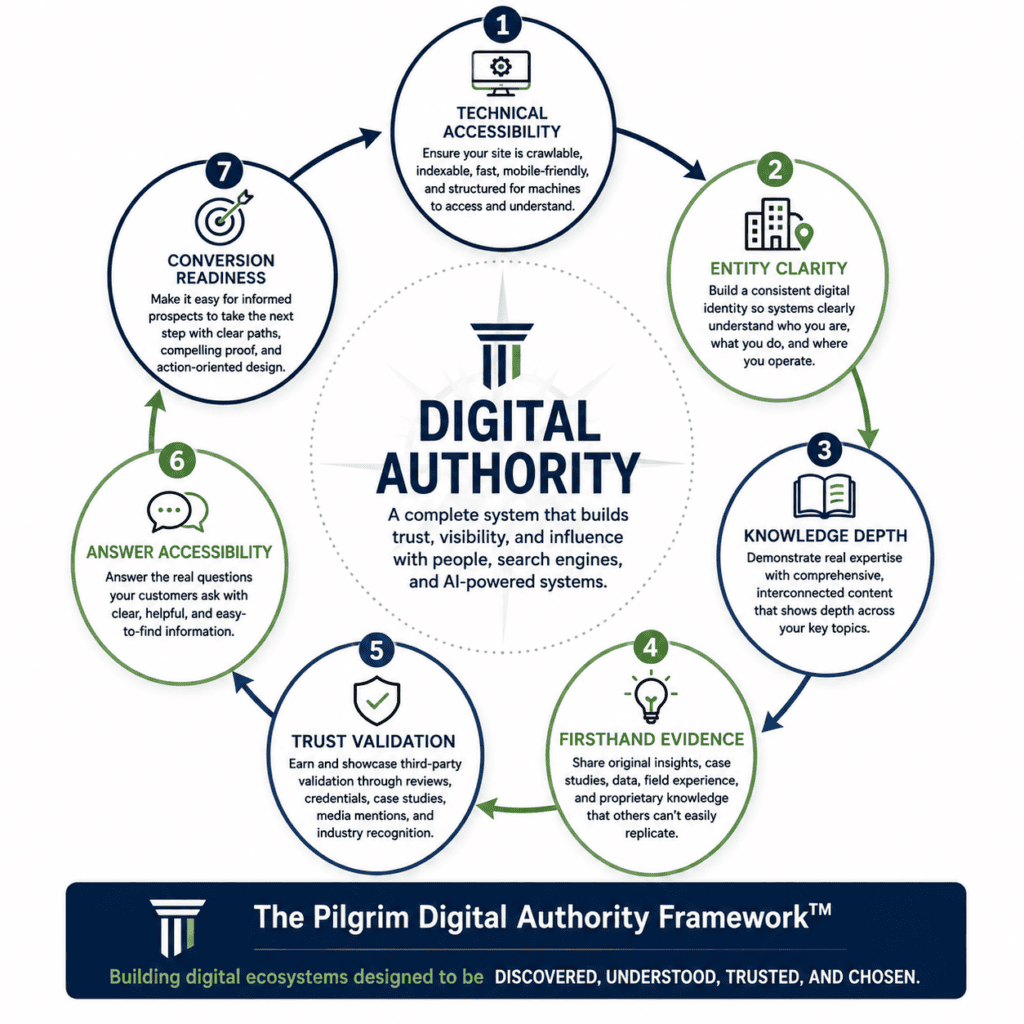
These seven layers should not operate independently.
Technical Accessibility allows information to be discovered.
Entity Clarity establishes who produced it.
Knowledge Depth demonstrates what the organization understands.
Firsthand Evidence makes that knowledge distinctive.
Trust Validation establishes credibility.
Answer Accessibility makes expertise useful during discovery.
Conversion Readiness transforms that authority into business opportunity.
Together, they create something much more powerful than a traditional business website:
A Digital Authority Engine.
The objective isn't simply to generate another website visit.
It's to build a digital presence capable of being discovered, understood, trusted, referenced, validated, and ultimately chosen.
Pilgrim Digital Authority Framework™:
Accessible → Understandable → Knowledgeable → Original → Trusted → Answerable → Actionable
That progression represents the changing job of the modern business website.
The question is no longer simply whether your website ranks.
The larger question is:
Does your entire digital presence provide enough evidence for customers—and the systems helping them make decisions—to recognize your organization as an authority?
From Advertising Frustration to Digital Authority: A Real Pilgrim Client Example
Frameworks are useful. Real-world results are more meaningful.
One of our service-business clients came to Pilgrim Consulting & Design after spending thousands of dollars on advertising with little to show for it.
The problem wasn't a lack of effort.
The company provided a legitimate service in its local market and had already invested substantially in trying to reach prospective customers online. But those advertising dollars weren't creating the visibility or customer acquisition the owner expected.
He was frustrated by a simple question:
Why was it so difficult for customers in his own service area to find his business online?
Rather than immediately recommending another advertising campaign, we examined the company's existing digital foundation.
We saw an opportunity to approach the problem differently.
Instead of Buying More Attention, We Started Building Authority
Pilgrim took over the company's website and reorganized its content strategy around five core service categories representing the areas in which the business needed to establish meaningful search visibility and expertise.
For each category, we developed a comprehensive authoritative pillar article.
Those five pillar resources became the foundation of a larger knowledge architecture.
From there, we began developing supporting authoritative articles around the questions, problems, services, and topics associated with each pillar.
But publishing more content wasn't the entire strategy.
We deliberately connected that information through a structured internal-linking system.
Supporting articles linked back to their relevant pillar resources. Pillar content connected readers to appropriate service pages and related educational content. Relevant authoritative external sources were incorporated where they strengthened the subject matter, while the company's website content was also connected with its broader presence across external social platforms.
Instead of isolated pages and disconnected blog posts, the website began developing into an interconnected knowledge ecosystem.
The Architecture Looked Something Like This
5 Core Service Categories
↓
5 Authoritative Pillar Resources
↓
Multiple Supporting Articles Around Each Pillar
↓
Strategic Internal Links Between Related Content
↓
Connections to Relevant Service Pages and Authoritative External Resources
↓
Connections Between Website Content and External Social Platforms
The objective wasn't simply to publish more.
It was to make the company's expertise easier for customers and search systems to discover, navigate, understand, and associate with the services the business actually provided.
What Happened Next
Within approximately two months, we observed a dramatic improvement in the client's local search visibility for important service-related searches.
The business began appearing more prominently against competing providers in its service area, and the owner started seeing the commercial impact of that increased organic visibility.
Most importantly, the company was no longer dependent on continuously purchasing advertising simply to generate attention.
The business began gaining meaningful traction through the digital authority it was building organically.
For an owner who had previously spent thousands of dollars trying unsuccessfully to buy visibility, the change was significant.
What This Case Taught Us
The lesson wasn't that advertising doesn't work.
Advertising can be extremely effective when the strategy, audience, offer, tracking, landing experience, and underlying digital foundation are right.
The lesson was different:
Advertising rents attention. Digital authority builds an asset.
When advertising stops, paid visibility generally stops with it.
Authoritative content, intelligent site architecture, internal linking, strong service relevance, and a growing knowledge ecosystem can continue creating discoverability long after an article is published.
This client didn't simply need more traffic.
He needed the digital ecosystem surrounding his business to provide stronger evidence of what the company did, what it knew, which problems it solved, and why it was relevant to customers searching for those services in his market.
That is the difference between maintaining a website and deliberately building a Digital Authority Hub.
And it demonstrates why the Pilgrim Digital Authority Framework™ isn't simply about ranking pages.
It's about creating a digital foundation capable of turning a company's real-world expertise into discoverability, trust, and business opportunity.
PILGRIM FIELD INSIGHT: Before spending more money trying to buy attention, determine whether your digital foundation has earned enough authority to capture the demand that already exists.
A New Metric: Citation-Worthy Content
Businesses should begin asking a fascinating question during content creation:
“Is this page worth citing?”
Not:
Did we use the keyword enough?
Not:
Did we publish 1,500 words?
But:
Did we contribute something useful enough that another person, publication, search engine, or AI system would want to reference it?
That raises the standard considerably.
Citation-worthy content tends to contain things such as:
- clear explanations
- original observations
- useful statistics
- expert commentary
- transparent methodology
- comparison frameworks
- practical checklists
- definitions
- data
- diagrams
- case studies
- credible external references
OpenAI's ChatGPT Search, for example, provides links to web sources within search-supported answers and allows users to inspect cited sources. Public websites can potentially appear in ChatGPT search, provided they are accessible to its search crawler and meet other applicable requirements.
So the opportunity is not merely:
Rank #1.
It may also become:
Become part of the answer.
Your Website Has a New Job
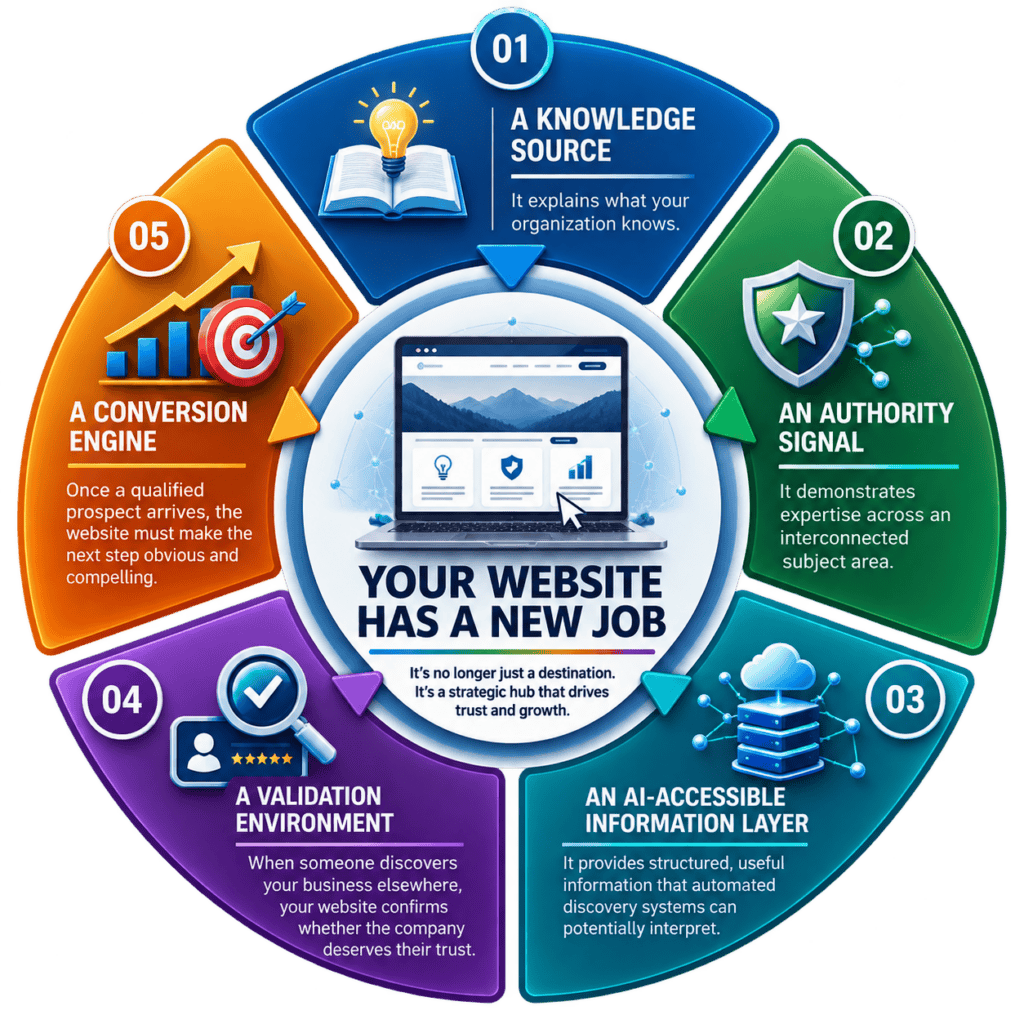
This brings us back to the title.
Your website isn't the destination anymore.
At least, not exclusively.
It is becoming several things simultaneously.
A Knowledge Source
It explains what your organization knows.
An Authority Signal
It demonstrates expertise across an interconnected subject area.
An AI-Accessible Information Layer
It provides structured, useful information that automated discovery systems can potentially interpret.
A Validation Environment
When someone discovers your business elsewhere, your website confirms whether the company deserves their trust.
A Conversion Engine
Once a qualified prospect arrives, the website must make the next step obvious and compelling.
That is a considerably more sophisticated role than the traditional online brochure.
Also Read 💻 How Can XR (AR/VR) Transform Websites Into Functional Experiences?
The Companies That Understand This Early Have an Advantage
We are still early in this transition.
That is important.
Many businesses are responding to AI search by asking:
“How do I optimize for ChatGPT?”
That question is understandable.
But it may be too narrow.
A better question is:
“How do we build enough digital authority that intelligent discovery systems consistently understand who we are, what we know, and where our expertise belongs?”
That requires more than SEO.
It involves:
Brand + Content + Technical SEO + Expertise + Reputation + Structured Information + Digital PR + User Experience + Conversion Strategy
Together, those components form something larger.
They form a Digital Authority Engine.
And that is where the future of the business website becomes extremely interesting.
💻OpenAI — ChatGPT Search and publisher guidance
The Bottom Line

The website is not dying.
The old definition of the website is.
A five-page digital brochure may technically establish an online presence, but presence alone is becoming less valuable in a world where customers can ask intelligent systems to research problems, explain solutions, compare approaches, and identify potential providers.
Businesses need to become discoverable before the click, credible during the research process, convincing after the visit, and memorable when the buying decision happens.
That requires thinking beyond traffic.
Beyond rankings.
And even beyond the website itself.
The next generation of successful companies will build digital authority ecosystems designed to participate in the entire customer journey.
Because increasingly, the most important question will not be:
“Did they visit our website?”
It will be:
“Were we part of the answer?”
💻Pew Research Center — AI summaries and search behavior research
Services
What Comes Next: Building the Authority Engine
Understanding the change is only the beginning.
The next challenge is practical:
What does an AI-era authority website actually look like?
How should its pages be structured?
What content should a business create?
How do SEO, internal linking, expertise, structured data, case studies, FAQs, reviews, video, and conversion strategy work together?
And how can a small or midsized business build this without becoming a publishing company?
That is the subject of the next article in this series:
From Digital Brochure to Authority Engine: How to Build a Website That Earns Trust Before the First Click
Social Media Optimization
Pilgrim Consulting & Design

At Pilgrim Consulting & Design, we believe the future of digital marketing isn't about chasing every new algorithm.
It's about building businesses that are genuinely worth discovering.
That means creating digital strategies where websites, SEO, content, AI discovery, branding, email, social media, and conversion strategy work together rather than existing as disconnected marketing tactics.
The technology is changing.
The customer journey is changing with it.
Your digital strategy should too.
Ready to turn your website from an online brochure into a digital authority engine? Talk with Pilgrim Consulting & Design about building a strategy designed for the way customers are discovering businesses now—and where that journey is heading next.
☎️Contact
Frequently Asked Questions
1. How is AI changing the customer journey?
AI is moving research and education earlier in the customer journey. Instead of visiting several websites immediately, customers can ask Google, ChatGPT, and other AI-powered systems complex questions, compare approaches, learn terminology, and evaluate potential solutions before visiting a company's website. As a result, businesses increasingly need to establish authority before the first website visit.
2. Are business websites becoming less important because of AI?
No. Their role is changing. A website may no longer be the first place a customer goes for information, but it remains critical for validating expertise, demonstrating credibility, explaining services, presenting case studies and proof, and converting informed prospects into customers. The website is evolving from a digital destination into an authority and conversion hub.
3. What is a Digital Authority Engine?
A Digital Authority Engine is an interconnected digital ecosystem that helps establish a business as a trusted source within its field. It can include the company's website, technical SEO, educational content, topic clusters, original expertise, case studies, entity signals, reviews, structured information, professional profiles, media mentions, social content, and other authoritative digital assets.
4. How can a business improve its visibility in AI search?
There is no guaranteed formula for being cited or recommended by an AI system. Businesses can strengthen their overall discoverability by maintaining technically accessible websites, publishing useful and original content, answering real customer questions, developing deep topical coverage, demonstrating firsthand expertise, maintaining consistent business information, earning credible third-party recognition, and following sound SEO practices.
5. Is traditional SEO still important in the age of AI search?
Yes. Technical SEO remains part of the infrastructure that allows search systems to discover, crawl, index, interpret, and retrieve website content. Crawlability, indexing, page speed, mobile usability, site architecture, internal linking, descriptive headings, accessible content, and appropriate structured data remain important. AI discovery expands SEO; it does not eliminate its foundations.
6. What is the difference between keyword-focused content and question-focused content?
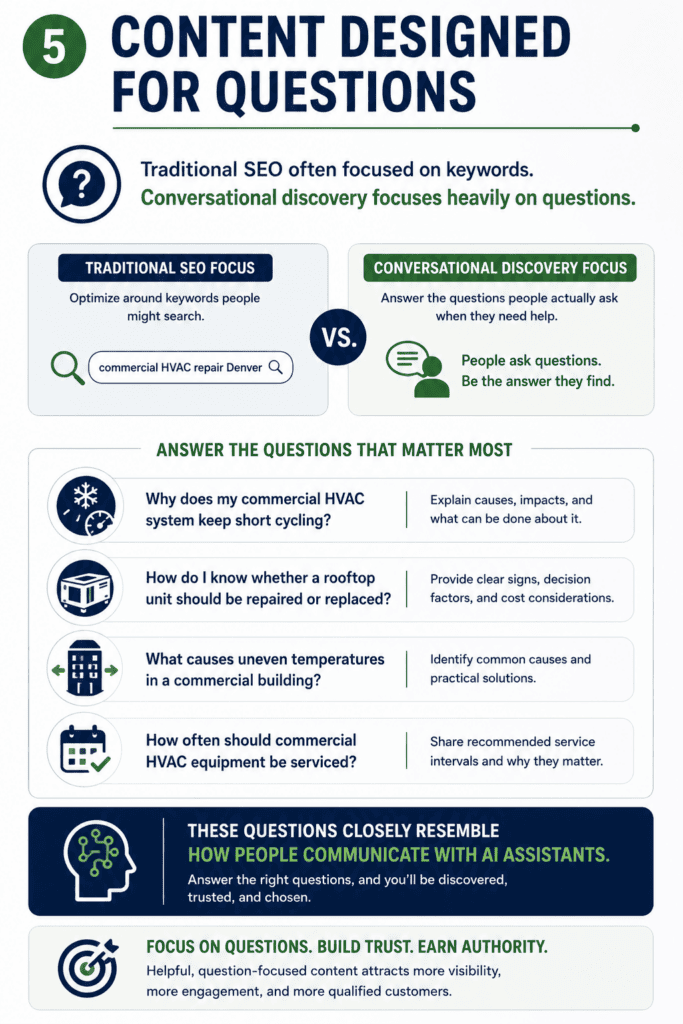
Keyword-focused content traditionally targets phrases people type into search engines, such as “commercial HVAC repair Denver.” Question-focused content addresses the actual problems behind those searches, such as “Why does my commercial HVAC system keep short cycling?” Conversational questions increasingly resemble the way people interact with AI assistants, making comprehensive answers an important component of modern content strategy.
7. Why are topic clusters important for digital authority?
Topic clusters allow a business to demonstrate depth rather than publishing disconnected articles. A cybersecurity company, for example, could build interconnected resources around ransomware, phishing, MFA, endpoint security, cyber insurance, backups, compliance, employee training, incident response, Microsoft 365 security, and business continuity. Together, these resources create a stronger knowledge ecosystem around the company's expertise.
8. Why will original expertise become more valuable as AI-generated content increases?
AI can summarize widely available information extremely efficiently, which makes generic informational content easier to produce. Businesses can differentiate themselves through knowledge derived from real experience—including customer questions, field observations, operational data, proprietary processes, case studies, benchmarks, failure patterns, original research, before-and-after results, and expert perspectives. The easier generic information becomes to create, the more valuable genuine firsthand insight becomes.
9. What are entity signals, and why do they matter?
Entity signals are the digital information that helps search engines and other systems understand who a business is, what it does, where it operates, who its experts are, what industries it serves, and how it is recognized elsewhere online. Consistent information across the company's website, directories, professional profiles, reviews, publications, social platforms, and industry resources helps create a clearer digital identity.
10. What should businesses measure if website traffic is no longer the whole story?
Traffic remains useful, but businesses should look beyond visitor volume. Important indicators can include qualified conversions, branded searches, engagement with authoritative content, visibility for important customer questions, referral sources, citations and mentions, lead quality, conversion rates, and whether prospects arrive already understanding the company's expertise. The larger strategic question is shifting from “How many people clicked?” to “Are we becoming part of the answer customers trust?”